
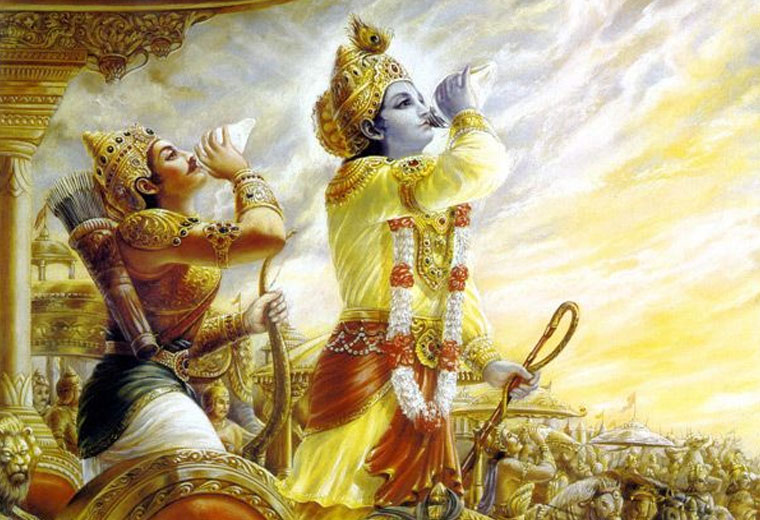
“In his doubt, he inquired from his secretary Sañjaya, “What did they do?” He was confident that both his sons and the sons of his younger brother Pāṇḍu were assembled in that Field of Kurukṣetra for a determined engagement of the war. Still, his inquiry is significant. He did not want a compromise between the cousins and brothers, and he wanted to be sure of the fate of his sons on the battlefield.”
Let us analyse this sentence:
- “In his doubt, he inquired from his secretary Sañjaya, “What did they do?”:
We understand: Dhritrarastra asks ‘what did they do?’ because he was worried the influence of the holy place would make Duryodhana change his mind about fighting.
- “He was confident that both his sons and the sons of his younger brother Pāṇḍu were assembled in that Field of Kurukṣetra for a determined engagement of the war.”
We understand: Dhritrarastra knew that Duryodhana and the Pandavas went to Kurukshetra with the intention to fight.
- “Still, his inquiry is significant.”
We understand: The fact that Dhritrarastra asks ‘What did they do?’ shows that he is worried that the atmosphere of the holy place would generate some piety in Duryodhana, and he would change his mind.
- “He did not want a compromise between the cousins and brothers, and he wanted to be sure of the fate of his sons on the battlefield.”
We understand: Dhritrarastra did not want his sons to make a peace treaty with the Pandavas and return any of their kingdom. He wanted reassurance that Duryodhana had not changed his mind about fighting and killing the Pandavas.
Evidence to support our understanding:
“Now, the word is used = yuyutsavaḥ. “They assembled for fighting.” Then what is the use of asking, kim akurvata, “Then what did they do?” It is natural to conclude that when they assemble for fighting, there must be fighting. But why he was asking, kim akurvata? The suspect was that because the parties assembled in the dharma-kṣetra, so they might have changed their ideas. Still, in India, if there is two fighting parties, they go to a temple and ask that “You say the right thing.” So in the temple, still, in the villages, they do not dare to speak lies. Yes. The fighting and the misunderstanding becomes settled up.
So Dhṛtarāṣṭra was thinking whether the two parties, they have settled up. He did not like that. He wanted that “These Pāṇḍavas should be killed, and my sons,” I mean to say, “the Kauravas, they should come out victorious so that there will be no enemy.” He was very much anxious to place his sons on the throne. Because he was blind, he could not acquire the throne. His younger brother was situated on the throne. Now, after the death of his younger brother, he thought that “I missed the opportunity of sitting on the throne. Why not my sons? They have got actual right.” Lecture 1972
Insights:
In this same lecture, Srila Prabhupada shares his personal insight that Dhritrastra was correct in thinking that the holy place of Kurukshetra would influence the fighters, but he didn’t realise it would influence Arjuna, not Duryodhana. Srila Prabhupada points out that holy places have a positive effect on devotees, not on the impious.
“But another thing is the dharma-kṣetra, effect of dharma-kṣetra, was visible in Arjuna. Dharma-kṣetra. He, because he’s devotee of Kṛṣṇa… Yasyāsti bhaktir bhagavaty akiñcanā sarvair guṇais tatra samāsate surāḥ [SB 5.18.12]. Because he’s devotee of Kṛṣṇa, therefore he felt = “What is this? Why shall I kill these, my brothers?” Because he was devotee. This sentiment came into the mind of Arjuna, not on the other side, Duryodhana. He never thought—although they were placed, both of them placed at dharma-kṣetra. The effect of dharma-kṣetra was manifest in the body of Arjuna, not Duryodhana. This is the… If one is pure, then the effects of dharma becomes manifest very quickly…… So the effect of Kurukṣetra, dharma-kṣetra, was visible in the person of Arjuna, not in the person of Duryodhana. That is the difference. Therefore he was crying = “So I am put in such a position that I have to fight and I have to kill my brothers, my nephews, my grandfather.” He was too much affected. Although it is weakness, but it is not actually weakness; it is compassion. Arjuna was not a coward, neither he was less heroic than the other side. But out of compassion, because he was devotee.” Lecture 1972
Chintamani’s Insight: I never understood why I don’t seem to get a devotional boost when I go to Vrindavan or Mayapura. Now I understand that I do not have sufficient piety for such sacred places to automatically boost my devotion.
Question: What is the most effective way to increase our devotional piety?
Our light: focus my energy on hearing from Srila Prabhupada and discussing his books as much as I can.
Evidence to support our light:
“To hear the glories of the Supreme Personality of Godhead from the mouth of a pure devotee is to acquire a pious life. In Bhagavad-gītā (7.28) it is also said that without being pious one cannot engage in devotional service…” Srimad Bhagavatam 4.22.22 purport
“If you simply hear, you’ll acquire some pious result. Punya-sravana-kirtanah. And if you chant, you get more pious result. Punya-sravana-kirtanah. The result will be hrdy antah-stho hy abhadrani. All abhadrani, all mischievous things will be washed away. Hrdy antah-stho hy abhadrani vidhunoti. Vidhunoti. Krsna helps you to wash it away because He’s your friend. He’s everyone’s friend, but a special friend to the devotees. Suhrt-satam.” Lecture 1973
0 Comments