

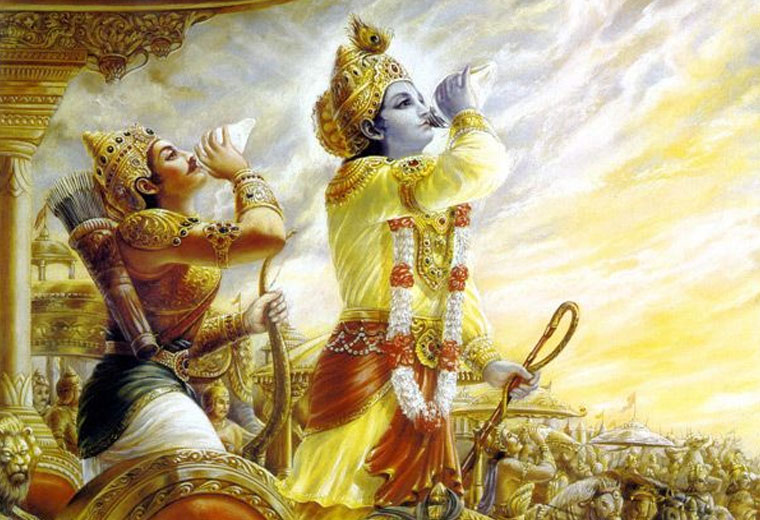
Let’s analyse this sentence:
- “Due to his impatience”:
On exploring what Srila Prabhupada might mean by this phrase, we found this conversation:
“Prabhupāda: Yes, He’s coming, Kṛṣṇa, personally, “Rascal, give up all these ideas. Surrender unto Me.” But who is accepting it? He’s coming for this purpose; He’s leaving His instruction, Bhagavad-gītā; He’s sending His devotee; but who is caring to accept that? He’s very much anxious to do good to you. But if you don’t accept, what can be done?
Vipina: In the case of a devotee…
Prabhupāda: Devotees, they accept. Therefore they are happy. And they’ll be happy. They’ll go back to home happy. One who accepts, he becomes happy.
Vipina: Well, in the case where a devotee is definitely sincerely following your instruction and applying himself to all these principles that Kṛṣṇa has outlined, then when there’s difficulty for him, how is he to understand that?
Prabhupāda: He cannot understand immediately. He must be patient. Utsāhān dhairyāt [Upadeśāmṛta 3]. Dhairya means patience. He cannot…, if you have sown some seed, you cannot expect immediately tree and fruits. You must wait. You must nourish the plant, water it. Śravaṇa-kīrtana-jale karaye secana [Cc. Madhya 19.152].
Vipina: But if there is some difficulty that causes so much trouble in your service…
Prabhupāda: That is impatience. That is impatience. Either he does not do properly his duty, or he is impatient.
Hari-śauri: Impatience means fruitive. Fruitive. He’s looking for some results.
Prabhupāda: Immediate result, immediately.” Morning walk 1976
From the above excerpt, we understand that ‘due to his impatience’ means Arjuna is questioning whether to fight, as it will not give him immediate happiness. On the contrary, the immediate result will be grief.
- “…he was forgetting himself…”:
In exploring what it means to ‘forget’ oneself, we found these excerpts:
“He’s forgetting his duty, kṣatriya duty. Therefore he’s admitting….. ‘my natural duty I am forgetting.’” Lecture 1973
“He who identifies with the body commits practical suicide. He forgets himself. Those who are sinful forget their spiritual identity, and they have to take another body.” Prabhupada Lilamrita
“As soon as he forgets his relationship with God, he identifies himself with the material world, that “I am a product of this material world,” the problem is created. But that is also due to his forgetfulness of God; therefore real problem is that he has forgotten his relationship with God.” Conversation 1973
“Forgetfulness is explained = māyā. We forget Kṛṣṇa. We forget that “I am part and parcel of Kṛṣṇa” by forgetfulness.” Lecture 1972
From the above, we understand that Arjuna forgot he is the Lord’s servant and that his specific service to the Lord was to fight in this war.
- “…on account of this weakness of his mind.”
We understand “weakness of the mind” is synonymous with weakness of the heart as the mind is in the region of the heart.
“then the heart (the seat of the mind)”. Srimad Bhagavatam 2.10.30 verse
Srila Prabhupada speaks about weakness of the heart in Bg 15.20 purport:
“The most important thing one has to surmount is weakness of the heart. The first falldown is caused by the desire to lord it over material nature. Thus one gives up the transcendental loving service of the Supreme Lord. The second weakness of the heart is that as one increases the propensity to lord it over material nature, he becomes attached to matter and the possession of matter. The problems of material existence are due to these weaknesses of the heart.”
The heart is the seat of the soul. “Fall down of the heart” refers to the degradation of the soul’s knowledge and desire. The soul originally knows that Krishna is the owner and controller of all energies, and thus desires Krishna’s pleasure. The first degradation is that the soul misconceives that he can independently control Krishna’s energies.
Evidences which support this understanding:
“The spirit soul bewildered by the influence of false ego thinks himself the doer of activities that are in actuality carried out by the three modes of material nature.” Bg 3.27 verse
“”They say they are the ‘doers’, they are independent. No! No! Completely under the grip of material nature!” Lecture 1975
Initially, he wants to control Krishna’s energy and use it in Krishna’s service. This is the case even with Lord Brahma:
“Here the word bheda-dṛṣṭyā occurs because Brahmā has a slight inclination to think that he is as independent as Rudra. Sometimes Brahmā thinks that he is independent of the Supreme Lord, and the worshiper also thinks that Brahmā is independent. For this reason, after the destruction of this material world, when there is again creation by the interaction of the material modes of nature, Brahmā comes back…..In the Śrīmad-Bhāgavatam it is accepted that as long as one thinks that he is equal with the Supreme Personality of Godhead, he is not completely purified or knowledgeable.” Srimad Bhagavatam 3.32.12-15 purport.
The second fall down occurs when the conditioned soul becomes greedy to enjoy the Lord’s property. Below is evidence to support this understanding:
“You cannot become the enjoyer. You are enjoyed. But when you want to imitate Kṛṣṇa and want to become enjoyer, then you are sent in this material world. This is material world.” Lecture 1974
“When the living entities desire to enjoy themselves, they develop a consciousness of duality and come to hate the service of the Lord. In this way the living entities fall into the material world.” Srimad Bhagavatam 4.28.53 purport
In conclusion, we understand Arjuna was restless and forgot his responsibility to fight because he thought he was an independent doer and enjoyer. In other words, he thought his actions alone determined outcomes, and that right action should result in his enjoyment.
Question 1: How could Arjuna, Krishna’s eternal friend, forget he is always dependent on Krishna and should act for His pleasure?
Our light: By Krishna’s will, he has temporarily forgotten Krishna is the Supreme Personality of Godhead. Krishna will begin reminding him of that in chapter 4, and by chapter 10, text 12-14 Arjuna will express his full acceptance of this fact.
“But Arjuna, he is always friend of Kṛṣṇa, constant friend. His name is Guḍākeśa, “above all darkness.” Certainly he must be. One who is Kṛṣṇa’s friend directly, how there can be ignorance? There cannot be. Then why Arjuna is playing that part? He knows Kṛṣṇa’s desire; still, he says that yadi mām apratikāram aśastram śastra-pāṇayaḥ. And no… Tan me kṣemataraṁ bhavet. He is playing like that. Because without playing, Arjuna’s playing like that, how this Bhagavad-gītā will come? This is just like, just like playing on the stage. One very rich man, he is, in a drama, he is playing the part of a very poor man. But actually he is not poor man. But in the stage he is playing the part of a poor man. Similarly, Arjuna is not bewildered, but for the time being he appears to be bewildered by Kṛṣṇa’s māyā, because Kṛṣṇa wants to speak Bhagavad-gītā for the benefit of the whole world, that what is spiritual knowledge. Therefore this is a stage arrangement.” Lecture 1973
Question 2: What distinguishes a weak heart from a strong one?
Our light: A weak heart has either insufficient or no attraction to Krishna, and is therefore unable to resist the temptations of lust. A strong heart has an unwavering, unmotivated attraction to Krishna.
“When a living entity comes in contact with the material creation, his eternal love for Kṛṣṇa is transformed into lust, in association with the mode of passion. Or, in other words, the sense of love of God becomes transformed into lust, as milk in contact with sour tamarind is transformed into yogurt. Then again, when lust is unsatisfied, it turns into wrath; wrath is transformed into illusion, and illusion continues the material existence.” Bg 3.37 purport
Question 3: How can we strengthen our attraction to Krishna?
Our light: By discussing sastra correctly.
“A sincere student should not neglect the discussion of such conclusions, considering them controversial, for such discussions strengthen the mind. Thus one’s mind becomes attached to Śrī Kṛṣṇa. By such conclusive studies I know the glories of Lord Caitanya. Only by knowing these glories can one become strong and fixed in attachment to Him.” CC Adi lila chapter 2, verses 117 and 118
“In the association of pure devotees, discussion of the pastimes and activities of the Supreme Personality of Godhead is very pleasing and satisfying to the ear and the heart. By cultivating such knowledge one gradually becomes advanced on the path of liberation, and thereafter he is freed, and his attraction becomes fixed. Then real devotion and devotional service begin.” Srimad Bhagavatam 3.25.25 verse
Question 4: How do we know if our attraction to Krishna is increasing?
Our light: By how eager we are to hear about Krishna.
“The eagerness to hear about God is the first qualification of a devotee eligible for entering the kingdom of God.” Srimad Bhagavatam 1.2.16 purport
0 Comments