

One of the main aims of our Improving Sanga initiative is to encourage families to discuss scripture together. We have seen the positive effect this has on relationships and our spiritual lives. Unfortunately, I often hear men describe how they struggle to discuss with their wives. This can be due to many reasons, and I can certainly relate to most of them. Although my wife, Cintamani, is now my best discussion partner with whom I enjoy fruitful discussions twice daily, we, too, have been through our challenges.
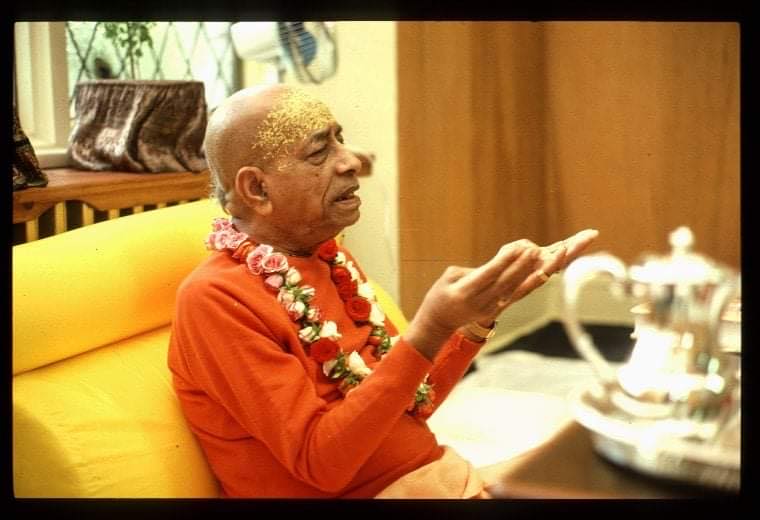
Our discussions began around thirty years ago when I was a temple president and ISKCON director. After the birth of our third child, my wife could no longer attend the temple programme with me. Consequently, her spiritual life suffered. Eventually, I gave up going to the temple and began to do my morning sadhana with her. From hearing Srila Prabhupada, I understood that my most important duty was to her and my children. He writes in the Srimad Bhagavatam (5.5.18 purport): “First the father, spiritual master or husband must be able to release the dependent from repeated birth and death. If he cannot do this, he plunges himself into the ocean of reproachment for his unlawful activities. Everyone should be very responsible and take charge of his dependents just as a spiritual master takes charge of his disciple or a father takes charge of his son.”
At first, I interpreted this to mean that I should assume spiritual authority over my wife by giving her classes. After all, this was the standard model in ISKCON. A senior devotee spoke, and everyone listened passively, maybe with a question or two at the end. However, it was soon apparent that this would not be my best approach. My wife is very thoughtful and questioning. We had plenty of arguments as we worked on our relationship and reviving her waning faith, but I knew that if I failed to help her overcome her doubts, they would overcome her.
We also listened to Srila Prabhupada often and noted how he frequently said we should discuss his books. Particularly in the early days, when he had more time for direct personal interaction with his disciples, he would encourage them to discuss philosophy with him, raise their doubts, and not accept anything unquestioningly. “Don’t take it as a sentiment or as a blind faith. You have got reason; you have got arguments; you have got sense. Apply it and try to understand it. Neither it is bogus. It is scientific. Then you will feel… Taj-josanad asv apavarga-vartmani sraddha ratir bhaktir anukramisyati.” Lecture 1966.
In other words, don’t be a passive hearer or blind follower.
As we heard Srila Prabhupada describe how we should discuss together, we were also learning techniques for empathic, responsible communication to become better parents. This fed into our discussions, and gradually, they became much more peaceful. I realised my role as a husband and father should be more interactive than didactic, getting my family thinking for themselves, as we do now in Improving Sanga. But there were still many other challenges we had to face.
As I began by saying, men often find it challenging to discuss with their wives, which I can relate to from my experience. As the husband, I grappled for quite some time with the conviction that my perspective must be superior to my wife’s. After all, I was an ‘older’ devotee (by two whole years), I knew more sastra and was the ‘pati-guru’. If Cintamani had a different perspective from mine, it wasn’t easy to accede that it may have merit. This would result in outright arguments or at least tension. My body language would cause her problems, and the discussion would become strained. She also found it hard to accept my perspective if it differed from hers. There was subtle rivalry and passive aggression on both of our parts. We have both had to work on resolving this. For my part, my nonverbal communication was most disturbing to Cintamani, prompting her to withdraw from the interaction. I tended to look away, pull strange faces, appear completely bored, fold my arms and cross my legs in a defensive posture, or frown in disapproval if my wife said something I disagreed with. I struggled with this for years, believing that my facial expressions did not always indicate my feelings, but it was still highly off-putting to Cintamani. Of course, the expressions often reflected my mood, but I lacked the self-awareness to recognise it. I have had to introspect and become aware of my feelings and how I communicate them non-verbally. I am now much more conscious of the effect of body language, an important component in any communication, and my attitude has improved.
Fundamentally, I have had to work on my false ego and accept that I am not always right and that my long-cherished belief in my vast spiritual knowledge may be mistaken. This has been the beauty of our discussions; by drilling down into the finer points of our philosophy, I have sometimes discovered that I had not properly understood some of the basic tenets. I’m realising that knowledge begins with humility. Krishna is in everyone’s heart and can give insights to anyone. Never mind my wife, I have heard some great insights from my children. After all, we are spirit souls, not the body. I have also seen that discussions work best when we seek synergy. Some of our most profound realisations have emerged when I have patiently assisted my wife in exploring and deepening her understanding, or when she has done the same for me. But to experience these moments, we have had to work on opening our hearts, becoming aware of each other’s emotional triggers, and acting compassionately towards each other. If I am attached to my own understanding and only go through the motions of understanding Cintamani with the intention of showing her how wrong she is, we cannot experience the magic of discussions. Attitude is everything. I feel my efforts to improve and become a better discussion partner have been more than worthwhile. My daily discussions with Cintamani are much more enjoyable and, indeed, critical to sustaining my spiritual life.
Cintamani has also worked on how she addresses me when problems arise. Any time she was upset with me, she would generalise, saying things like, “You always do such and such,” or “You never listen to me.” I found this greatly discouraging and had to tell her how to own her feelings without accusing and blaming me. I suggested she say, “I’m sure you don’t mean it, but when you do/say things like that, it makes me feel like this.” It took my wife and me years and many heart-to-heart conversations to overcome the major issues we faced, but because we are conditioned souls, these difficulties still sometimes recur. But we are determined to keep trying because we see the great value of the discussions. I have also seen the importance of having good sadhana, and we always make it a point to do our rounds and the morning and evening programmes.
As a result of our efforts to improve, we both feel materially, emotionally and spiritually supported by the other. Our marriage has become a true ashrama or shelter.
If you are interested in learning how to improve your own discussions, please join the Improving Sanga community, where we discuss these things and assist one another.
Yours in Krishna’s service
Krishna dharma das


0 Comments