
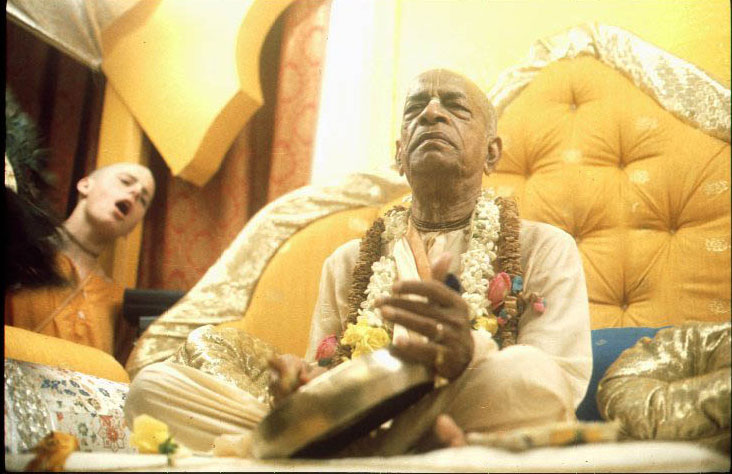
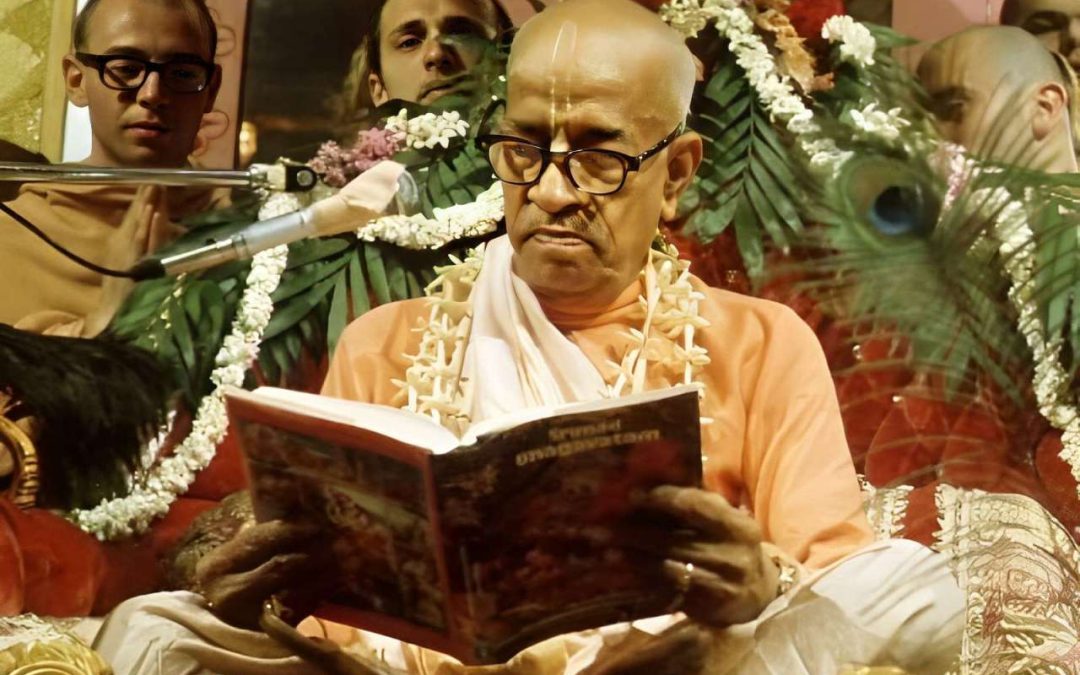
Srila Prabhupada tells us we cannot understand the Srimad Bhagavatam if we are not pure:
“Simple hearing is not all; one must realize the text with proper attention. The word niviṣṭa means that Sūta Gosvāmī drank the juice of Bhāgavatam through his ears. That is the real process of receiving Bhāgavatam. One should hear with rapt attention from the real person, and then he can at once realize the presence of Lord Kṛṣṇa in every page. The secret of knowing Bhāgavatam is mentioned here. No one can give rapt attention who is not pure in mind. No one can be pure in mind who is not pure in action. No one can be pure in action who is not pure in eating, sleeping, fearing and mating.” Srimad Bhagavatam 1.3.44 purport
If we read alone or listen passively, we will inevitably interpret Krishna’s teachings through the filter of our material conditioning. For example, if we are predominantly in the mode of ignorance we will interpret Krishna’s teachings in a misogynistic or racist fashion; if predominantly in the mode of passion we will interpret it to justify seeking power, position, and opulence; and if predominantly in the mode of goodness we will think the goal of bhakti is liberation from repeated birth and death.
“Devotional service executed by a person who is envious, proud, violent and angry, and who is a separatist, is considered to be in the mode of darkness. The worship of Deities in the temple by a separatist, with a motive for material enjoyment, fame and opulence, is devotion in the mode of passion. When a devotee worships the Supreme Personality of Godhead and offers the results of his activities in order to free himself from the inebrieties of fruitive activities, his devotion is in the mode of goodness.” (SB 3.29.8-10)
“A separatist is one who sees his interest as separate from that of the Supreme Lord. Mixed devotees, or devotees in the modes of passion and ignorance, think that the interest of the Supreme Lord is supplying the orders of the devotee; the interest of such devotees is to draw from the Lord as much as possible for their sense gratification. This is the separatist mentality.” (SB 3.29.9 purport)
“But if this offering process is in the mode of goodness rather than in pure devotion, then the interest is different.” (SB 3.29.10 purport)
All these misinterpretations are opposed to Krishna’s desire.
Conditioned souls can only advance in Krishna consciousness and get free of these unwanted tendencies if trained in proper sadhu sanga.
“Generally, people cannot understand. But if one understands, he becomes liberated. If some way or other….it is not very difficult; simply we have to associate with devotees and discuss this literature. Then we will understand Krishna very easily.” Lecture 1976
In 1972, Srila Prabhupada began asking his leaders to focus on this training. Unfortunately, that didn’t happen, and consequently many devotees are not well acquainted with the nuances of Krishna’s teachings.
Subsequently, after Srila Prabhupada’s physical departure, seeing that devotees lacked scriptural discernment, the GBC decided to control who they could accept initiation from. The ostensible reason was that Srila Prabhupada wanted this and it was the only way to protect devotees from impostor gurus. However, the practice of authorising gurus contradicts Srila Prabhupada’s teachings and one of the prominent early leaders, Tamal Krishna Goswami, admitted it was not what Srila Prabhupada wanted. He suggested that the decision to do this was influenced by material ambition.
“Actually, Prabhupada never appointed any gurus. He didn’t appoint eleven gurus. He appointed eleven ritviks. He never appointed them gurus. Myself and the other GBC have done the greatest disservice to this movement the last three years because we interpreted the appointment of ritviks as the appointment of gurus….. I can say definitely for myself, and for which I humbly beg forgiveness from everybody, that there was definitely some degree of trying to control. There’s a degree of this in most GBC’s parts, in most temple president’s parts. This is the conditioned nature, and it came out in the highest position of all. “Guru, oh wonderful. Now I’m a guru, and there’s only eleven of us.” This is what led us into this pitfall. The GBC who weren’t gurus said, “I’m next in line.” This has screwed up our movement terribly.” — Tamal Krishna Goswami
It is hardly surprising that there could have been material ambition in their hearts. In the absence of regular and good sadhu sanga, any of us would likely have done the same in their position. They had been devotees for no more than eleven years. Achutyananda das recalls that Srila Prabhupada said even the venerable Lalita Prasada, Srila Bhaktisiddhanta Maharaja’s brother, was still affected by material ambition:
Achyutananda: He looked exactly like their father, Bhaktivinode Thakur. In his house I saw some of the hand written books written by Bhaktivinode Thakur. At that time Prabhupada was living in Bhaktivinode Thakur’s birthplace in Birnagar. Prabhupada said, “We will take care of you. We will develop this place. It will be an international center.” Lalita Prasad said, “Yes, but I must be guru. You must step down and I must be acharya.” Prabhupada said, “Okay,” and we left. Prabhupada then looked at me and said, “I didn’t believe it, that even after giving up lust, desire for prestige lingers on even to the end.” When I asked him, “What broke up the Gaudiya Matha?” Prabhupada said, “They were always worried who was going to give initiation. They couldn’t wait a few years until a guru manifested?” He said, “My god-brothers were fighting over material properties and money.” Srila Prabhupada Lila
Anyone on the path of purification will struggle with such anarthas, up to the time we finally attain an advanced stage of prema known as sthayi bhava:
“When one actually becomes situated on the transcendental platform, he becomes steady. Unless one is so situated, his position is not steady and he may fall down. When one is actually situated transcendentally, there is no fear of falling down. This stage is technically called sthāyi-bhāva.” Teachings of Lord Caityana, chapter 1
The Srimad Bhagavatam describes this stage of unadulterated devotional service as follows:
“The manifestation of unadulterated devotional service is exhibited when one’s mind is at once attracted to hearing the transcendental name and qualities of the Supreme Personality of Godhead, who is residing in everyone’s heart. Just as the water of the Ganges flows naturally down towards the ocean, such devotional ecstasy, uninterrupted by any material condition, flows towards the Supreme Lord.” Srimad Bhagavatam 3.29.11-12 verse
Proper sadhu sanga is therefore required, even up to attaining prema. If we neglect this, our judgment can be clouded by the influence of the modes of nature.
“The root cause of devotional service to Lord Kṛṣṇa is association with advanced devotees. Even when one’s dormant love for Kṛṣṇa awakens, association with devotees is still most essential.” CC M 22.83 verse
It is a mistake for us to think we can be purely motivated without doing proper sadhu sanga daily.
Srila Prabhupada, however, is not a conditioned soul like us. He is an eternally liberated soul who was with Krishna in Goloka and descended to help us at Krishna’s request.
Bhavananda das remembers: “He said,
“Krishna asked, ‘I want you to write those books. Come down and write those books.‘” Prabhupada said to Krishna, “But I don’t want to go to the material world.” Krishna said, “Don’t worry. I’ll take care of everything. You write those books.“
Furthermore, Krishna came to him every morning and dictated his books.
“Every morning when I sit here to write my books Krsna comes personally and he dictates to me what to write, I simply take dictation from Krsna and I write these books.” Srila Prabhupada
Some may find this unbelievable, but if we don’t trust what Srila Prabhupada says about himself, there is no point being affiliated with ISKCON. If we trust him, we should not lightly equate him to other spiritual masters, who are ascending souls. No matter how advanced they are, in the absence of regular good sadhu sanga, they are liable to make mistakes even up to the initial stage of prema. Therefore, it behoves every ISKCON member, especially the leaders, to assiduously practice sadhu sanga, as Srila Prabhupada repeatedly instructed as early as 1972.

0 Comments