

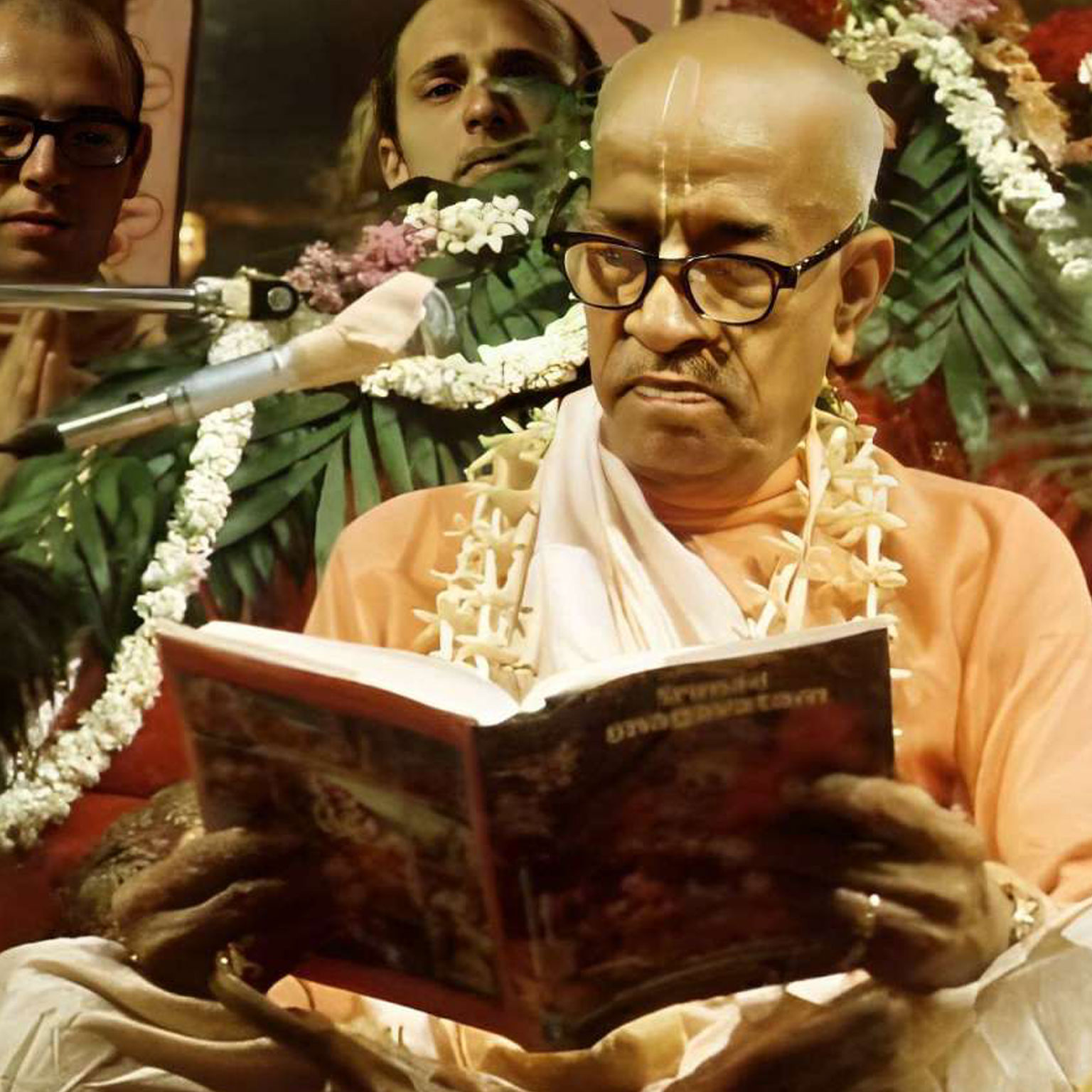
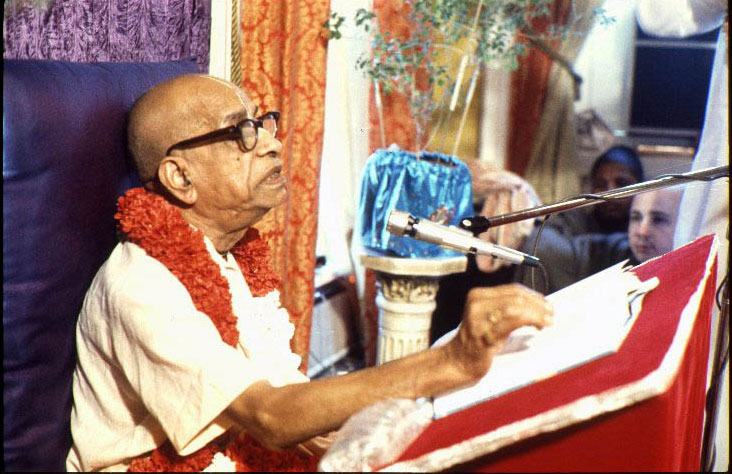
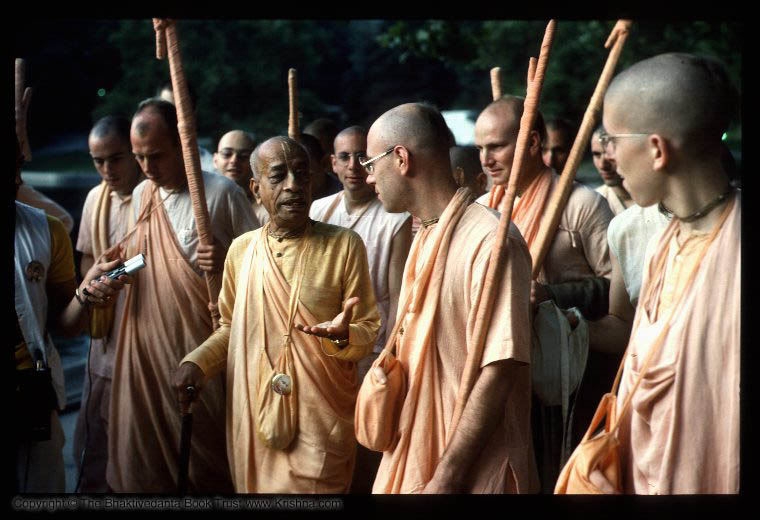
For sadhu sanga to be effective, we must associate with, i.e. hear from, a genuine sadhu. As we show in ‘Some Thoughts On Sraddha To Nishtha’, this means the bona fide guru, Srila Prabhupada. There is no dispute in ISKCON about his status, but a great deal of disagreement when it comes to accepting others as sadhus, or bona fide spiritual masters. One person’s saint can be another’s complete neophyte. However, Srila Prabhupada’s instructions allow for different types or levels of guru. It is not that one must be on the highest platform, an uttama adhikari, to act in the capacity of spiritual master. One can be a madhyama or kanishtha adhikari, a second or third-class devotee, but then the role is defined differently from that of the first-class devotee.
Srila Prabhupada and the Lord himself wanted us all to become spiritual masters.
“Lord Chaitanya wanted everyone should be a spiritual master provided he follows the order of Lord Chaitanya. The Lord’s mission was to defeat the mayavada philosophy and establish the philosophy of Krishna consciousness because Krishna is the Supreme Lord the Personality of Godhead. anyone following the order of Lord Chaitanya under the guidance of his bonafide representative, can become a spiritual master and I wish that in my absence all my disciples become the bonafide spiritual master to spread Krishna consciousness throughout the whole world. I want it…” Letter to Madhusudan, 11/2/67
However, he gave apparently conflicting instructions about who can accept the role of guru. Sometimes he asserted that one must be a first-class devotee.
“The guru must be situated on the topmost platform of devotional service. There are three classes of devotees, and the guru must be accepted from the topmost class.” CC Madhya Lila 24.330.
Atmavit means a self-realized soul or bona fide spiritual master. Unless one is self-realized and knows what his relationship with the Supersoul is, he cannot be a bona fide spiritual master. Srimad Bhagavatam (SB) 3.28.2
At other times, he allowed for those on lower levels to become gurus.
“One should not become a spiritual master unless he has attained the platform of uttama-adhikārī. A neophyte Vaishnava or a Vaishnava situated on the intermediate platform can also accept disciples, but such disciples must be on the same platform, and it should be understood that they cannot advance very well toward the ultimate goal of life under his insufficient guidance. Therefore, a disciple should be careful to accept an uttama-adhikārī as a spiritual master.” Nectar of Instruction Text 5 commentary.
However, although he says second and third-class devotees can be gurus, he also says one should be careful to accept only a first-class devotee, as he said in the other statements we quoted. This apparent contradiction can be resolved by understanding the roles of the different levels of gurus.
In Easy Journey to Other Planets, paraphrasing CC M 22.115-134, Srila Prabhupada writes as follows:
“3. The candidate must be prepared to satisfy the spiritual master in every way. A bona fide spiritual master who is fully cognizant of the methods of spiritual science, learned in the spiritual scriptures such as the Bhagavad-gita, Vedanta Srimad-Bhagavatam and Upanishads, and who is also a realized soul who has made a tangible connection with the Supreme Lord, is the transparent medium by which the willing candidate is led to the path of the Vaikunthas. The spiritual master must be satisfied in all respects, because simply by his good wishes a candidate can make wonderful progress along the path.
He must not take on unlimited disciples. This means that a candidate who has successfully followed the first twelve items can also become a spiritual master himself, just as a student becomes a monitor in class with a limited number of disciples.”
Here, Srila Prabhupada defines the role of the second or third-class guru, comparing them to a ‘monitor in a class’. Monitor is specifically an Indian term, like a university tutor who helps other students understand the professor’s teachings. We understand from this that those who are not professors or first-class devotees, described in point three above, should act as teachers or gurus by assisting others to comprehend the lessons of the “bona–fide spiritual master”. Srila Prabhupada defines the latter as a “realized soul who has made a tangible connection with the Supreme Lord,” which we understand means the highest level of uttama adhikari, one who knows their eternal relationship with Krishna. The ‘monitor’, on the other hand, may not even be brahman realised, as we find that this is mentioned in point 16 on Srila Prabhupada’s list, where he says, “In the next stage, the candidate does not become afflicted by lamentation and illusion.” This refers to Bhagavad–gita 18.54, which defines the stage of brahman realisation as na sochati na kankasati, neither desiring nor lamenting.
Before discussing how we feel the ‘monitor’ guru should act, we must mention what we view as a serious problem arising from the GBC’s policies concerning initiations. Since 1978, soon after Srila Prabhupada’s departure, the GBC has been creating diksha gurus through an approval process. (Please see A Critical Evaluation of ISKCON’s Initiation System, where this is discussed in detail.) Only such approved devotees can give initiation in ISKCON. Those accepting diksha from a ‘non-approved’ devotee are not allowed to serve in the institution. As the GBC do not distinguish its appointed gurus from Srila Prabhupada by terming them ‘monitor’ type gurus, they are widely accepted as first-class devotees, especially by their disciples. This generally held conception is reinforced by Srila Prabhupada’s statements about the necessity of the bona fide spiritual master being an uttama adhikari. Many devotees know the statement in Nectar of Instruction cited above, allowing second or third-class devotees to take disciples, but as it is said there that the disciples of such gurus “cannot advance very well toward the ultimate goal of life”, we doubt if you will find many devotees who do not consider their guru an uttama adhikari. Thus, they accept their guru as the qualified sadhu or pure devotee from whom they should hear, consequently minimising the importance of hearing directly from Srila Prabhupada. This has been our experience as we try to teach the principles of Improving Sanga.
This phenomenon has created various problems in ISKCON. As many of the approved gurus later showed themselves to be far from first class (some 40% had fallen by 2024), it has been embarrassing for the society and led to many devotees losing faith in the leadership. Those whose gurus have fallen have often become disenchanted and gone away from the society of devotees. Even where the gurus have not been exposed as unqualified, the fact that so many have fallen calls them all into question. Indeed, the GBC approval does not mean much, and it is quite possible that disciples are not receiving the right sadhu sanga and thus not making much advancement under the “insufficient guidance” of those they accept as sadhus or pure devotees.
There has also been significant pushback against the GBC approved gurus from a breakaway group known as the ‘Ritviks’, who assert that Srila Prabhupada left instructions that only he should give diksha, even after his departure, when officiating priests or ritviks would initiate on his behalf. We won’t go into the details here, but suffice it to say that this group continue to gain followers, despite being declared apostates by the GBC, as more and more instances of approved guru abuses and delinquency come to light.
The GBC’s approach to the problems has created a swathe of legislation, attempting to control gurus and disciples and outlaw those who defy these rules, such as the ritviks and anyone bold enough to give diksha without approval. Here at Improving Sanga, we suggest a different approach, centred around hearing from Srila Prabhupada and discussing his teachings. Train and empower devotees to have scriptural discernment and think for themselves rather than letting the GBC do it for them. Srila Prabhupada wanted this, not bureaucratic lawmaking.
Krishna Consciousness Movement is for training men to be independently thoughtful and competent in all types of departments of knowledge and action, not for making bureaucracy. Once there is bureaucracy the whole thing will be spoiled. Letter to Karandhara, 1972
He also said that laws alone cannot control people. They require training.
Simply enforcing laws and ordinances cannot make the citizens obedient and lawful. That is impossible. Throughout the entire world there are so many states, legislative assemblies and parliaments, but still the citizens are rogues and thieves. Good citizenship, therefore, cannot be enforced; the citizens must be trained. SB 9.10.50 purport
He also made it clear that this should be the GBC’s duty.
“So especially you (leaders) must encourage the students to read our books throughout the day as much as possible, and give them all good advice how to understand the books, and inspire them to study the things from every point of view. …So let us concentrate on training our devotees very thoroughly in the knowledge of Krishna consciousness from our books, from tapes, by discussing always, and in so many ways instruct them in the right propositions.” Letter to Hamsaduta, 22nd June, 1972
Improving Sanga is our attempt to fulfil the above instruction. Let’s train devotees to recognise a bona fide guru and thus engage in effective sadhu sanga. Stop endorsing often unqualified individuals as genuine sadhus and let devotees decide for themselves. Returning to the role of the ‘monitor’ type guru, we suggest that this should be assisting those in their care to associate with Srila Prabhupada by discussing his books with them. This will provide the necessary training and fulfil the requirement that we hear from the uttama adhikari spiritual master, Srila Prabhupada. Our sadhu sanga will thus work as it should, gradually deepening our faith and taking us to the higher stages of bhakti. If non-liberated gurus accept this appropriate position rather than allowing themselves to be seen as first-class bona fide spiritual masters, it will prevent many problems. They will not be forced into pretending to be something they are not, and other devotees will not be seen as offensive if they question their philosophical understanding. Improving Sanga discussions are the best way to do this in a respectful and mutually beneficial way. Gurus and disciples will progress together. This is only possible when the guru has a limited number of disciples, and hence the sastric injunction to that effect. The current system overloads gurus with too many disciples they can’t manage, to the detriment of both parties.
We therefore humbly request ISKCON leaders to consider our proposal carefully. The GBC has stated that Srila Prabhupada should be everyone’s “foundational siksha guru”, and we can think of no better way of implementing this than through the principles he taught, which we have collated as the Improving Sanga methodology. Thank you for reading this article. Hare Krishna.

Only this kind of understanding can save us from idol worship and impersonalism. Thank you!
Hare Krishna Anandamayi prabhu,
please accept our humble obeisance. All glories to Srila Prabhupada. Thank you for your encouraging feedback.
your servants,
the Editors.
Harihol
thank you . It is great to know we can think for ourselves ! but would you be so kind to explain how your comments on “ you should do this and bhy that and this one us qualified or not “ jow is your statements any different from those of GBC ? i dj like the idea for thinking for myself and as for studying books, i read many times about linking into Parampara is a very clear and basic statement thank you
Hare Krishna Gaura prabhu,
please accept our humble obeisance. All glories to Srila Prabhupada.
thank you for reading and engaging with our article: Different Types of Guru. We would like to respond to your question, but unfortunately due to the typos we are not able to understand what the question is. Kindly consider joining our Whatsapp community and directly communicating with us via that. Or if you prefer, please type out your question again here, but be careful not to have any typos that obscure your meaning.
your aspiring servants,
The Editors.