

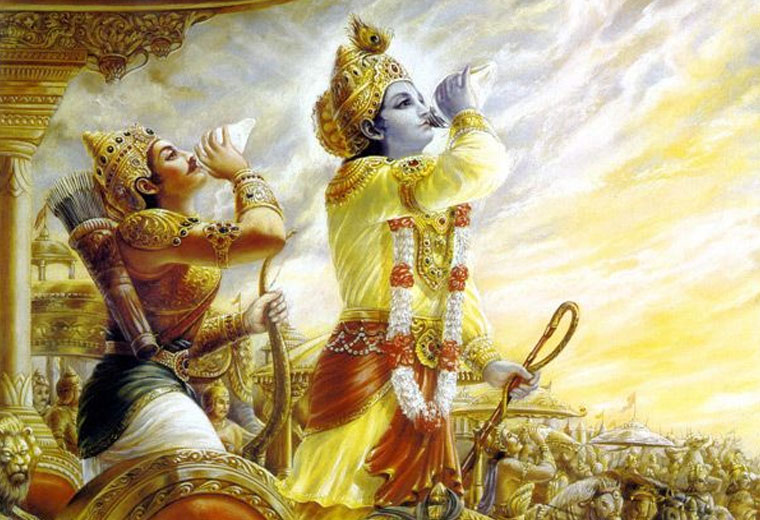
“The example of clear understanding is there in the Bhagavad-gita itself, in the way the teaching is understood by Arjuna, who heard the Gītā directly from the Lord.”
We understand the entire sentence to mean: Arjuna is someone who has properly understood the Gita. He tells us what he understands in the Gita.
Question 1: What was Arjuna’s conclusion on hearing Krishna’s teachings?
Our light: That Krishna is the Supreme Personality of Godhead.
Our Evidence:
“How Arjuna accepted this Bhagavad-gītā should be noted. His manner of acceptance is given in the Tenth Chapter (10.12–14):
arjuna uvāca
paraṁ brahma paraṁ dhāma
pavitraṁ paramaṁ bhavān
puruṣaṁ śāśvataṁ divyam
ādi-devam ajaṁ vibhum
āhus tvām ṛṣayaḥ sarve
devarṣir nāradas tathā
asito devalo vyāsaḥ
svayaṁ caiva bravīṣi me
sarvam etad ṛtaṁ manye
yan māṁ vadasi keśava
na hi te bhagavan vyaktiṁ
vidur devā na dānavāḥ
“Arjuna said: ‘You are the Supreme Personality of Godhead, the ultimate abode, the purest, the Absolute Truth. You are the eternal, transcendental, original person, the unborn, the greatest. All the great sages such as Nārada, Asita, Devala and Vyāsa confirm this truth about You, and now You Yourself are declaring it to me. O Kṛṣṇa, I totally accept as truth all that You have told me. Neither the demigods nor the demons, O Lord, can understand Your personality.’
“After hearing Bhagavad-gītā from the Supreme Personality of Godhead, Arjuna accepted Kṛṣṇa as paraṁ brahma, the Supreme Brahman. Every living being is Brahman, but the supreme living being, or the Supreme Personality of Godhead, is the Supreme Brahman. Paraṁ dhāma means that He is the supreme rest or abode of everything; pavitram means that He is pure, untainted by material contamination; puruṣam means that He is the supreme enjoyer; śāśvatam, eternal; divyam, transcendental; ādi-devam, the original Supreme Personality of Godhead; ajam, the unborn; and vibhum, the greatest.”
Bg Introduction.
In other words, Arjuna concluded that Krishna is indeed the Supreme Personality of Godhead, and all His teachings are authoritative. We should also come to this conclusion.
Question 2: Does believing Krishna is the Supreme Personality of Godhead constitute understanding Bhagavad-gita as Arjuna did?
Our light: There is a difference between blindly accepting something and properly understanding.
“There is a story, it is very instructive story, that Nārada Muni was passing to go to Vaikuṇṭha, and on the way one very learned scholar, brāhmaṇa, met him, and he inquired from Narada Muni where he was going. Nārada Muni said that “I am going to see Nārāyaṇa, my Lord.” So the brāhmaṇa asked him, “Oh, you are going to meet Nārāyaṇa. Will you kindly inquire for me when my…, when I shall be liberated,” Nārada Muni said, “Yes, I shall inquire.”
Similarly, on the way, he met one cobbler. He also inquired Nārada Muni where he was going, and he said, will you kindly inquire from Lord Nārāyaṇa when he would be liberated? So when Nārada Muni met Nārāyaṇa, so he inquired—because he’s saintly person; he promised—that “Such-and-such brāhmaṇa inquired like this, and the…, and a cobbler also inquired like this.” So Nārāyaṇa said, “The…, this cobbler will be liberated in this life, and that brāhmaṇa will take some time, some many births.”
So Nārada Muni became astonished that he, he was a learned scholar and brāhmaṇa, and he would take so much time, and the cobbler would be liberated in this life? “Oh, what is the reason, Sir?” So Nārāyaṇa gave him one needle, and He requested him that “When they inquire what Nārāyaṇa was doing, you can say that Nārāyaṇa was pulling one elephant through the hole of the needle, this side and that side,” in this way.
So when he came back, the brāhmaṇa said, “Sir, you are… I offer my respectful obeisances unto you and Nārāyaṇa. We cannot believe this, that through the needle, or through the hole of a needle, an elephant is being passed, this side and that side.” And when it was informed to the cobbler, he began to cry. He said, “Oh, my Nārāyaṇa is so powerful that He can do everything.” He believed immediately that “Yes, for Nārāyaṇa it is possible to pull the elephant through the hole of the needle, this side and that.”
So Nārada Muni inquired, “How do you believe this? The other person, the brāhmaṇa, he’s learned person. He did not believe. How do you believe it? What is your conviction?” He said, “Sir, I believe in this way, because I am sitting under this tree. This is a banyan tree. And so many,” what is called, “figs are falling down. And each fig there are thousands of small seed, and in each seed there is a banyan tree. So if Nārāyaṇa can keep thousands of banyan trees within this fig fruit, how it is not possible for Him to pull an elephant through the hole of a needle?”
So this is called faith. The faith is not blind. There is proof. He…, the cobbler was not blindly believing that Nārāyaṇa was pulling an elephant through the hole of a needle, but he sees practically the potency, the power of the Lord, bījo ‘haṁ sarva-bhūtānām, how He keeps all the potencies of the banyan tree within the seed. So otherwise there is no meaning “all-powerful.” He can do whatever He likes. Inconceivable.” Lecture 1972
In other words, we can only be said to have come to the same conclusion as Arjuna if we study Bhagavad-gita, understand Krishna’s message, and, on mature consideration, accept it. Accepting Krishna’s teachings when we don’t even understand them is simply blind faith.
“I do not mean faith by blind faith. This Bhagavad-gītā is not blind faith. Everything is being explained step by step, scientifically, authoritatively. So try to understand. And if you fortunately become faithful, then your life is successful.” Lecture 1969
Question 3: How can we tell if someone has properly understood Bhagavad-gita?
Our light: In Bhagavad-gita 10.8 and 10.9 we learn that one who truly understands that Krishna is the Supreme Personality of Godhead is always absorbed in thoughts of Him and in discussing His teachings with others in an enlivening and enlightening fashion.
Text 8: I am the source of all spiritual and material worlds. Everything emanates from Me. The wise who perfectly know this engage in My devotional service and worship Me with all their hearts.
Text 9: The thoughts of My pure devotees dwell in Me, their lives are fully devoted to My service, and they derive great satisfaction and bliss from always enlightening one another and conversing about Me.
0 Comments