

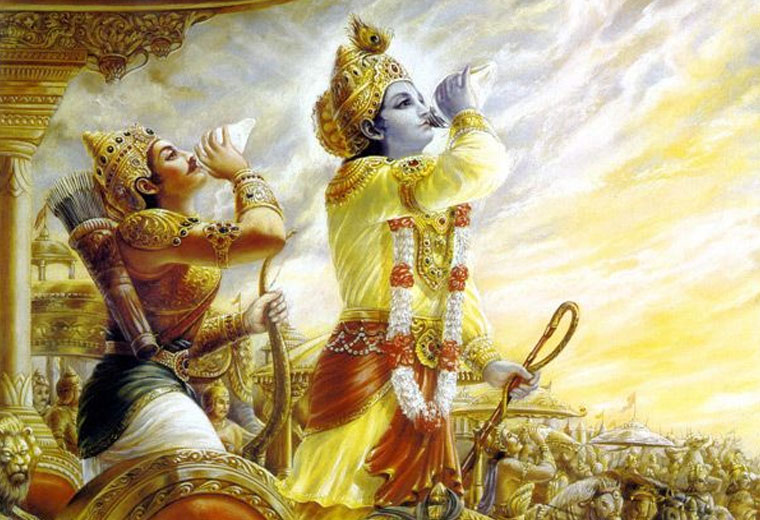
“Herein an estimation of comparative strength is made by Duryodhana. He thinks that the strength of his armed forces is immeasurable, being specifically protected by the most experienced general, Grandfather Bhīṣma. On the other hand, the forces of the Pāṇḍavas are limited, being protected by a less experienced general, Bhīma, who is like a fig in the presence of Bhīṣma.”
We understand: In Bg 1.10 verse, Duryodhana expresses his confidence that he will win on two counts:
- His army is far more powerful than the Pandavas’.
- His most powerful general, Bhishma, is more experienced than the Pandavas’ most powerful general, Bhima. By saying Bhima is a fig in comparison to Grandfather Bhishma, he means Bhima has no chance of surviving Bhishma’s attacks, let alone defeating him.
Confusion: Srila Prabhupada’s perspective of this verse is similar to Baladeva Vidyabhusana’s, but both of them contradict Vishvanatha Cakravarti Thakura, who writes in his commentary on this verse:
“Our troops are not up to standard: we cannot fight against the Pandavas. Even though protected all around by Bhisma, who has fine intelligence and is experienced in fighting and theory, Bhisma has partiality for both sides. The Pandavas are very well protected by Bhima, though having gross intelligence and not thoroughly conversant with fighting and theory. In other words, they are well equipped to fight against us.”
Thus, Vishvanatha Cakravarti Thakura says the opposite to Baladeva Vidyabhusana and Srila Prabhupada. According to him, the verse says that the Pandavas’ army is better than the Kauravas, and Bhima will protect them better than Bhishma will protect the Kauravas.
Though contemporaries, Baladeva Vidyabhusana was much younger than Vishvanatha Cakravarti Thakura, who was his siksha guru.
We therefore have two questions:
- Why then is his perspective on this verse the opposite of Vishvanatha’s, and why did Srila Prabhupada favour it?
- Is it not against Vaishnava etiquette to go against the perspective of one’s siksha guru?
Our justification for asking these questions:
“We repeat only. We don’t change = “Now hari-nāma is not curing, so let me add, instead of Hare Kṛṣṇa, ‘John Kṛṣṇa,’ if I may.” No. No “John Kṛṣṇa.” [laughter] That same Hare Kṛṣṇa must be repeated. And you will be cured. So change means imperfect knowledge. No change means that is perfect knowledge. So we follow that “no change” policy. No, not that because I think I have become now advanced, I change this to that. That means I am not advanced. My knowledge is imperfect; therefore I am changing.” Lecture 1972
Our lights on both questions:
Question 1: Why is Baladeva Vidyabhusana’s perspective on Bg 1.10 different to that of his siksa guru, Visvanatha?
Our light: There are circumstances when it is permissible to have different perspectives. For example, the acaryas give four different perspectives on why Krishna closed his eyes on seeing Putana. Srila Prabhupada writes in Krishna Book chapter 6:
“Kṛṣṇa showed the nature of a small baby and closed His eyes, as if to avoid the face of Pūtanā. This closing of the eyes is interpreted and studied in different ways by the devotees. Some say that Kṛṣṇa closed His eyes because He did not like to see the face of Pūtanā, who had killed so many children and who had now come to kill Him. Others say that Pūtanā hesitated to take the baby on her lap because something extraordinary was being dictated to her from within, and that in order to give her assurance, Kṛṣṇa closed His eyes so that she would not be frightened. And yet others interpret in this way: Kṛṣṇa appeared in order to kill the demons and give protection to the devotees, as stated in the Bhagavad-gītā: paritrāṇāya sādhūnāṁ vināśāya ca duṣkṛtām. The first demon to be killed was a woman. According to Vedic rules, the killing of a woman, a brāhmaṇa, cows or a child is strictly forbidden. Kṛṣṇa was obliged to kill the demon Pūtanā, and because the killing of a woman is forbidden according to Vedic śāstra, He could not help but close His eyes. Another interpretation is that Kṛṣṇa closed His eyes because He simply took Pūtanā to be His nurse. Pūtanā came to Kṛṣṇa just to offer her breast for the Lord to suck. Kṛṣṇa is so merciful that even though He knew Pūtanā was there to kill Him, He took her as His nurse or mother.”
Question 2: When is it permissible to have a different perspective to the previous acharyas and when is it not?
Our light: We cannot change the Sadhya and the sadhana. Srila Prabhupada explains the meaning of these words:
“When Caitanya Mahāprabhu was talking with Rāmānanda Raya, so Caitanya Mahāprabhu inquired, “What is the actual aim of life?” Sādhya-sādhana [Cc. Madhya 8.118]. Sādhya and sādhana. “What is the aim?” Sādhya means what for this human form of life we have got. That is called sādhya, the goal, the goal of life. And sādhana. Sādhana means the activity by which we can attain, we can achieve that goal of life. This is called sādhya-sādhana.” Lecture 1973
According to both CC Madhya 20.103 and CC Antya 6.234, sadhya and sadhana are both tattvas, truths, or in other words, unalterable realities.
According to CC Madhya 22.107 the goal of life is to awaken our dormant Krishna prema, and the process is to hear about and glorify him.
This is what Srila Prabhupada and all previous acharyas preach. According to CC Madhya 8.263 there are also other types of tattva. It is not permissible to deviate from tattva. Who to hear from and how to hear are also part of the sadhana.
It seems to us, therefore, that when the Acharyas differ in their perspectives, they differ in terms of rasa. However, until we are liberated, it is best we try to faithfully hear, understand, and repeat the teachings of our Founder-Acharya, and refrain from our own innovative lights if they contradict Srila Prabhupada’s:
“Hari-śauri: I always understood before that the rasa was fixed, but that within that rasa one may take different…, one may take a different line.
Prabhupāda: That will be revealed when you are liberated. Why you are bothering now?” Morning Walk 1976
0 Comments