

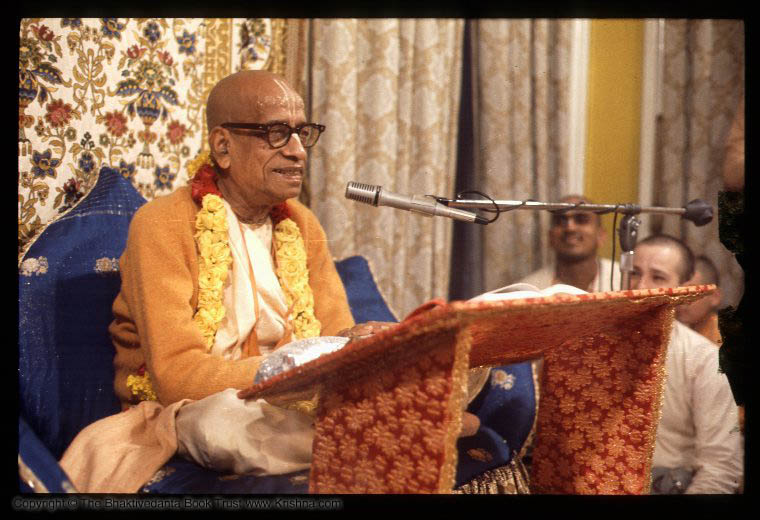
“Everything has an original cause, or seed. For any idea, program, plan or device, there is first of all the contemplation of the plan, and that is called the bīja, or seed. The methods, rules and regulations by which one is perfectly trained in devotional service constitute the bhakti-latā-bīja, or seed of devotional service.” CC Madhya 19.151 purport
To receive the bhakti-lata-bija, one must properly assimilate the instructions of the liberated spiritual master. If we fail to receive the bhakti–lata–bija, our faith will be misinformed, and we will likely incorrectly practise bhajana–kriya.
“Bhakti-latā-bīja means ‘the seed of devotional service.’ Everything has an original cause, or seed. For any idea, program, plan or device, there is first of all the contemplation of the plan, and that is called bīja, or the seed. The methods, rules and regulations by which one is perfectly trained in devotional service constitute the bhakti-latā-bīja, or the seed of devotional service. This bhakti-latā-bīja is received from the spiritual master by the grace of Kṛṣṇa. Other seeds are called anyābhilāṣa-bīja, karma-bīja and jñāna-bīja. If one is not fortunate enough to receive the bhakti-latā-bīja from the spiritual master, he instead cultivates the seeds of karma-bīja, jñāna-bīja or political and social or philanthropic bīja. However, bhakti-latā-bīja is different from these other bījas. Bhakti-latā-bīja can be received only through the mercy of the spiritual master. Therefore one has to satisfy the spiritual master to get bhakti-latā-bīja [yasya prasādād bhagavat-prasādaḥ]. Bhakti-latā-bīja is the origin of devotional service. Unless one satisfies the spiritual master, he gets the bīja, or root cause, of karma, jñāna and yoga without the benefit of devotional service. However, one who is faithful to his spiritual master gets the bhakti-latā-bīja. This bhakti-latā-bīja is received when one is initiated by the bona fide spiritual master. After receiving the spiritual master’s mercy, one must repeat his instructions, and this is called śravaṇa-kīrtana—hearing and chanting.” Room Conversation 1976
If our faith is misinformed, our practise will be misinformed. For example, we may adopt a renounced ashrama when we should have got married:
“So the asuras, they do not know what they should do and what they should not do. That is asura. And a devotee, he knows what to do and what not to do. There is no illicit sex. That is “do not.” But there is “do” also, that “If you want sex life, then get yourself married according to religious principle and get a wife and beget nice children.” That is “do.” And “No illicit sex,” that is “do not.” Side by side.” Lecture 1973
The bhakti-lata bija has two divisions: knowing the goal (sadhya) and the means to attain it (sadhana).
“What is the actual aim of life?” Sādhya-sādhana [Cc. Madhya 8.118]. Sādhya and sādhana. “What is the aim?” Sādhya means what for this human form of life we have got. That is called sādhya, the goal, the goal of life. And sādhana. Sādhana means the activity by which we can attain, we can achieve that goal of life. This is called sādhya-sādhana.” Lecture 1973
According to the Bhakti school, the goal of life is spontaneous, continuous attraction to hearing about and glorifying Krishna: His name, teachings, and pastimes.
“The manifestation of unadulterated devotional service is exhibited when one’s mind is at once attracted to hearing the transcendental name and qualities of the Supreme Personality of Godhead, who is residing in everyone’s heart. Just as the water of the Ganges flows naturally down towards the ocean, such devotional ecstasy, uninterrupted by any material condition, flows towards the Supreme Lord.” SB 3.29.11-12
The primary means of attaining this goal is hearing Krishna’s glories from the liberated spiritual master, chanting His name, and discussing His glories.
“After sowing this seed, one has to water it by chanting and hearing the holy name of the Supreme Lord and by taking part in discussions about the science of devotional service in a society of pure devotees.” Teachings of Lord Chaitanya, chapter 1
Both hearing and chanting Krishna’s name and discussing His teachings constitute sravanam–kirtanam, and together they are sankirtana, which is the yuga dharma and the essence of bhajana–kriya.
“This word saṅkīrtana is a Sanskrit word. Sam means samyak, “complete,” and kīrtana means “glorifying” or “describing.” Kīrtaye. So this complete description means complete glorification of the Supreme, of the Supreme complete whole.” Lecture 1969
“When we speak of hearing and chanting, it means that not only should one chant and hear of the holy name of the Lord as Rāma, Kṛṣṇa (or systematically the sixteen names Hare Kṛṣṇa, Hare Kṛṣṇa, Kṛṣṇa Kṛṣṇa, Hare Hare/ Hare Rāma, Hare Rāma, Rāma Rāma, Hare Hare), but one should also read and hear the Bhagavad-gītā and Śrīmad-Bhāgavatam in the association of devotees. The primary practice of bhakti-yoga will cause the seed already sown in the heart to sprout, and by a regular watering process, as mentioned above, the bhakti-yoga creeper will begin to grow.” Srimad Bhagavatam 2.2.30 purport
Many aspiring devotees do japa and kirtan and attend classes, but neglect discussing the Bhagavad-gita and Srimad Bhagavatam. This is a serious omission, as such discussions are crucial for developing informed faith and progressing in bhakti.
“In the association of pure devotees, discussion of the pastimes and activities of the Supreme Personality of Godhead is very pleasing and satisfying to the ear and the heart. By cultivating such knowledge, one gradually becomes advanced on the path of liberation, and thereafter he is freed, and his attraction becomes fixed. Then real devotion and devotional service begin.” Srimad Bhagavatam 3.25.25
By discussing Krishna’s teachings and pastimes with devotees who are not materially motivated, faith, attraction and spontaneous bhakti awaken consecutively: sraddhā ratir bhaktir anukramiṣyati.
In summary, the aspirant starts with a little curiosity, leading to discussing Srila Prabhupada’s books with other devotees. If done correctly, one receives the bhakti-lata-bija, the right conception of the goal and methods of bhakti.
However, if one fails to hear properly from Srila Prabhupada, the topmost liberated spiritual master, we may form the wrong conceptions about bhakti, confusing it with materialistic work, liberation, or even sinful inclinations.
“If one is not fortunate enough to receive the bhakti-latā-bīja from the spiritual master, he instead cultivates such seeds as karma-bīja, jñāna-bīja, or political, social or philanthropic bījas.” CC Madhya 19.152 purport
“Some unnecessary creepers growing with the bhakti creeper are the creepers of behavior unacceptable for those trying to attain perfection, diplomatic behavior, animal-killing, mundane profiteering, mundane adoration and mundane importance. All these are unwanted creepers.” CC Madhya 19.159
We therefore humbly entreat devotees to adopt the Improving Sanga principles, which we firmly believe is the best way to receive the bhakti–lata bija.
Om Tat Sat

0 Comments