

Click HERE for a PDF of the comprehensive version
Introduction
Dhṛtarāṣṭra is the eldest son of King Vicitravīrya and, by the principle of primogeniture, he should have inherited the kingdom. However, because Dhṛtarāṣṭra was blind, the throne passed to his younger brother, Pāṇḍu. Pāṇḍu died prematurely, leaving behind his five young sons, one of whom is Arjuna. Dhṛtarāṣṭra therefore ruled as regent until his nephews came of age.
He never came to terms with the fact that, because of his blindness, the throne would not pass to his own sons, even though they were able-bodied. Thus, along with his eldest son, Duryodhana, he plotted many schemes to kill the Pāṇḍavas. When those failed, he arranged for them to take part in a rigged game of dice, in which they lost their kingdom. The agreement was that, if they were not discovered, they would regain their kingdom after thirteen years.
The sons of Pāṇḍu—the Pāṇḍavas—successfully completed their thirteen years of exile. However, when they returned and asked for their kingdom, Dhṛtarāṣṭra and Duryodhana refused. If the Pāṇḍavas wanted their kingdom, they would have to fight for it.
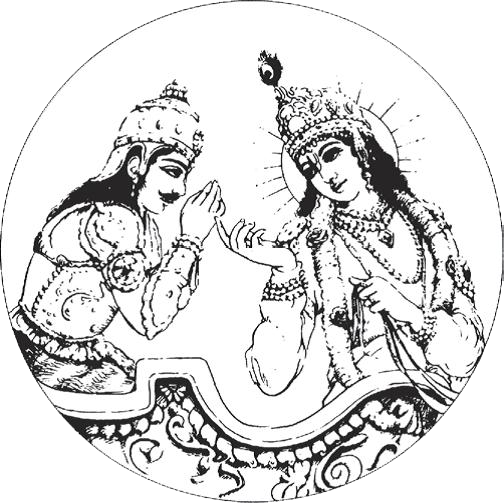
Kṛṣṇa, the Supreme Personality of Godhead, had descended to the earth at that time. His father, Vasudeva, was the elder brother of Arjuna’s mother, Kuntī (also known as Pṛthā). Kṛṣṇa and Arjuna were intimate friends, and thus Kṛṣṇa agreed to be Arjuna’s charioteer.
Verses
1.1: Dhṛtarāṣṭra said: My sons and Pandu’s sons have gathered at the sacred ancestral field of the Kurus dynasty, with the intention to fight. Please tell me Sanjaya, what are they going to do now. Has the energy of this holy site influenced my sons to change their minds?
1.2: Sanjaya replied: Your son Duryodhana looked out at the Pandavas’ army and noted their strong military formation. He then went to speak to his military teacher, Drona.
1.3: He said: Acarya Drona, see the Pandavas’ powerful army. Note how your own disciple, the intelligent Dhṛṣṭadyumna, has so expertly arranged their military formation.
1.4-8: He named some of the chief fighters in the Pandavas’ army and then those in his army.
1.9: Duryodhana continued: There are many other heroes whose names I have not mentioned who are also prepared to die for my cause. All of them are well equipped with different kinds of weapons, and all are experienced warriors.
1.10: My army is much greater numerically, and it is also protected by Grandfather Bhīṣma; whereas the Pandavas have a much smaller army and its most powerful protector is Bhima who I consider to be like a fig in comparison to Bhisma. Thus I am confident of our victory.
1.11: Duryodhana then became concerned that the other generals might feel overlooked, so he addressed them: All of you must give your full support to Grandfather Bhīṣma, and each of you should remain carefully stationed in your respective positions to protect him from all sides.
1.12: Bhīṣma, the grandfather of the Kuru dynasty knew Duryodhana was worried. To cheer him up, he blew his conch shell, and the sound resembled the roaring of a lion.
1.13: Suddenly, the other fighters on Duryodhana’s side blew their conches. Some also blew bugles, trumpets, and horns, and others beat drums. When all the instruments were played simultaneously, they created a tremendous sound.
1.14-15: On the other side of the battlefield, Krsna and Arjuna, seated on their great chariot, drawn by white horses, blew their conchshells which were imbued with spiritual potency. Lord Krsna blew his conchshell called Pancajanya, and Arjuna blue his, Devadatta. The powerful hero, Bhima, blue his tremendous conchshell, Paundra.
1.16-19: All the other fighters on Yudhiṣṭhira’s side also blew their conches. Among them were Yudhiṣṭhira’s Ananta-vijaya, Nakula’s Sughoṣa, and Sahadeva’s Maṇipuṣpaka. The combined uproar resounded everywhere — on land and in the sky — terrifying Duryodhana and his brothers.
1.20–23: Grasping his bow and arrows, Arjuna stood on his chariot, marked with the flag of Hanumān. He carefully surveyed his cousins, Dhṛtarāṣṭra’s sons, who stood at the head of the opposing army. Then he addressed his charioteer, Kṛṣṇa, as follows:
You are Acyuta—infallible—because neither Your power nor Your affection for Your devotee is ever compromised. Therefore, being Your devotee, I confidently depend on You. Please draw my chariot between the two armies. I want to see which of my friends and relatives have sided with the evil Duryodhana.
1.24–25: Kṛṣṇa drove the chariot into the middle of the battlefield and positioned it where Arjuna could clearly see both armies. As Bhīṣma, Droṇa, and all the other heroes looked on, Kṛṣṇa addressed Arjuna in a light-hearted tone: Well, Arjuna, because you are My aunt Pṛthā’s son, I have agreed to be your charioteer. Now that you can see all the Kurus who have come out to fight with you, I hope you will not change your mind about fighting.
1.26: From where he stood, Arjuna could see both armies. Looking from one party to the other, he saw elders who were like fathers and grandfathers to him. He saw his teachers, maternal uncles and brothers. He saw his young sons and grandsons as well as friends along with his fathers-in-law and many well-wishers.
1.27: When Kuntī’s son saw all his relatives and friends ready to kill each other, he became dismayed at the thought that soon many of them would be dead or wounded. In this distressed state he addressed Kṛṣṇa.
1.28-29: He said: I am devastated to see all these people I love ready to fight me. My entire body is shaking, my mouth is dry, I have goosebumps and my skin feels hot. I am so upset I cannot even hold onto my bow.
1.30: Kṛṣṇa, I do not feel able to remain here on the battlefield. I am so confused about what I should do that I have become dizzy and feel as if I could faint at any moment. It seems to me that whatever I do will lead to suffering. Even if I win the kingdom, I will suffer remorse. Thus, I see no good outcome, no matter what I do.
1.31–35: How can any good come from killing my own relatives? I have no interest in victory in battle or regaining my kingdom. Kṛṣṇa, you are known as Govinda, the giver of happiness to all. Surely you understand that a kingdom, worldly pleasures, or even life itself have no value for me if those whose happiness I desire are standing here ready to fight me. You are famous as Madhusūdana because you killed the demon Madhu, but these men are not demons. They are my teachers, men who have been like fathers to me, boys who are like sons, and others who are like grandfathers, maternal uncles, fathers-in-law, grandsons, brothers-in-law, and relatives. I will not kill them, even if it means I will be killed. Even if I were to gain rulership over all the planetary systems, I would still not kill them, what to speak of this earth. How can I do such a sinful act for a temporary semblance of happiness in this life? You are known as Janārdana—destroyer of people. If they must be killed for the sake of righteousness, then You, who do not incur sin, may do so.
1.36: Even though they instigated the hostility, I think it would be sinful to kill them. Therefore, it would be irreligious for me to kill Dhṛtarāṣṭra’s sons along with my kinsmen. Kṛṣṇa, as the husband of the Goddess of Fortune, please tell me what possible benefit there could be in killing them, and how that would make me happy.
Kṛṣṇa’s unspoken comment: If it is sinful to kill one’s family members, how is it that the warriors on the opposite side have challenged you to battle? As a kṣatriya, it is your duty to accept the challenge.
1.37–38: Arjuna said: The other side do not recognise any problem because their judgement is obscured by greed. Thus, they are blind to the sin involved in killing one’s family and friends. That does not mean I, who know better, should participate in this sinful act. Unlike them, Janārdana, I clearly see the fault in destroying the family.
1.39: With the death of all the men in a family, the codes of right conduct and the traditions of formal worship which were passed down from generation to generation are destroyed. The rest of the family will then drift away from a God-centred life and behave in ways that are harmful to themselves and to society.
1.40: Kṛṣṇa, when families become immoral and give up their God-centred way of life, the women in those families become prone to engaging in extramarital relationships. Consequently, O descendant of Vṛṣṇi, they have illegitimate children who lack discipline and a sense of their duties, thus creating serious problems in society.
1.41: When the number of illegitimate children in society increases, they create misery both for their own families and for society in general, which allowed the destruction of the traditional family unit to take place. Even the deceased ancestors of such families suffer, for no one performs the piṇḍa ceremony for their spiritual upliftment.
1.42: Those responsible for destroying the traditional family are also responsible for these evil consequences: the moral and spiritual degradation of society, women engaging in extramarital relationships, and the proliferation of illegitimate children. Consequently, they are also responsible for the destruction of community projects—such as providing for the vulnerable—and family welfare activities, such as taking proper care of elderly family members and children.
1.43: O Kṛṣṇa, those who are raised in spiritually dysfunctional families which do not instil in them discipline or a sense of duty inevitably go to hell. This is not my opinion, but what I have heard from spiritual authorities.
1.44: How unfortunate that we have resolved to commit the great sin of killing our own kinsmen, motivated by the selfish desire to enjoy royal privileges.
Kṛṣṇa’s unspoken comment: Even if you do not wish to fight, they are intent on killing you.
1.45: I will not take up arms nor will I resist, even if they attack me with their weapons. If Dhṛtarāṣṭra’s sons kill me, that will be more beneficial for me than if I kill them. Such a death will be my atonement for the sin of thinking of killing my relatives.
Dhṛtarāṣṭra’s unspoken comment: Then what happened?
1.46: Sañjaya said: When he had finished speaking, Arjuna sat down in his chariot, right there in the middle of the battlefield. Feeling overwhelmed with sadness, he cast aside his bow and arrows.
BRIEF CHAPTER SUMMARY:
King Dhṛtarāṣṭra asks Sañjaya what is happening at Kurukṣetra, where his sons and nephews have assembled to fight. In reply, Sañjaya describes Duryodhana’s inspection of the opposing army and his attempt to rally his commanders. The armies then sound their conches, and the battlefield fills with a powerful display of war.
Arjuna asks Kṛṣṇa to place his chariot between the two armies. Seeing his relatives and teachers on both sides, he is overcome with grief. Unable to see any good outcome, he rejects victory and argues that the war will destroy family life and social order. He refuses to fight and collapses in despair.
Click HERE for a PDF of the comprehensive version
CHAPTER 1
Access Gita Support articles in this series:
How to deepen your study of Chapter 2
How to Use Gita Flow to Deepen Your Study of Bhagavad-gītā As It Is (These suggestions currently apply only to Chapter 2, but we in time will add the relevant material to the other chapters as well.) What Gita Flow Provides There are three downloadable PDFs connected...
Gita Flow – Introduction
The Bhagavad-gītā is a conversation between a distraught Arjuna and his intimate friend, Kṛṣṇa, the Supreme Personality of Godhead. It is a coherent exchange in which Arjuna presents his doubts and confusions. He finds himself in an impossible situation. As we would...
Ch. 2 Easy Gita Flow
Note: An asterisk at the end of a verse indicates there is evidence related to it, which you will find below in the list of evidences. CHAPTER 2 2.1-3: Krishna scolds Arjuna (1 - 2) Sanjaya said, “When Krishna saw Arjuna so upset about killing his relatives, he said,...
Ch.3 Easy Gita Flow
Note: An asterisk at the end of a verse indicates there is evidence related to it, which you will find below in the list of evidences. CHAPTER 2 2.1-3: Krishna scolds Arjuna (1 - 2) Sanjaya said, “When Krishna saw Arjuna so upset about killing his relatives, he said,...
Gita Support is a work in progress. We will constantly improve it with time. Please feel free to provide us with your feedback on how we can improve it.
Footnotes:

0 Comments