

CHAPTER 2
Click HERE for the Comprehensive version
Click HERE for the Reflections
Click HERE for Recommended Hearing
Click HERE for an audio version of this chapter.
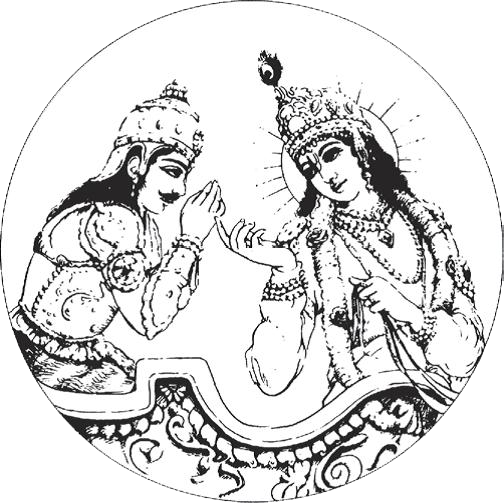
2.1: Sañjaya said: Arjuna’s eyes brimmed with tears. Overwhelmed by grief and compassion for his relatives, he wanted to leave the battlefield. Kṛṣṇa, the killer of the Madhu demon and the reservoir of all sweetness, spoke to dispel his friend’s ignorance.
(e)
2.2: The Supreme Lord said: What has clouded your judgement at this critical moment of the conflict? One who knows life’s higher purpose does not act like this. If you renounce your kṣatriya duty and leave the battlefield, you will neither attain liberation nor heaven. Furthermore, having lost your excellent reputation and being scorned by all, you will suffer in this life.
(h, e)
2.3: Arjuna, Lord Indra fathered you in the womb of my aunt Pṛthā. Thus, you have both the privilege of an outstanding lineage and the status of my intimate friend. It is therefore unbefitting for you to succumb to such unmanly and cowardly sentiments. O defeater of your foes, give up this foolishness clouding your judgement. Get up and prepare to fight.
(h, e)
2.4: Arjuna said: Even if they attack me, Bhisma and Drona remain my respected elders. O killer of the Madhu demon, you have never attacked your grandfather, King Ugrasena, or your teacher Sandipani Muni. How then, O killer of enemies, can I retaliate against my elders who deserve to be worshipped by me with flowers, rather than assailed by my arrows?
(h, e)
2.5: Ksatriyas are forbidden to beg. However, I would rather endure that humiliation than commit the sin of killing such saintly teachers. Though they choose to fight us for financial reasons, they are worthy of my veneration for their deep study of scripture, their practice of celibacy, and their mastery of time’s influence. Killing such respectable elders is a sin that will contaminate everything I may subsequently enjoy.
(e, r)
2.6: Furthermore, even if I fight, there is no guarantee I will win. Indeed, I am not sure whether I would rather win or lose. How would I live with myself after killing Uncle Dhrtarastra’s sons, for that is the only way to win, since they have all come out to oppose us?
(e, r)
2.7: I recognise that my unwillingness to fight is a fault, rooted in my miserly preference for enjoying family relationships over pursuing self-realisation. I am thus confused about my religious duty. Should I fight my elders and family members, or, out of respect for them, walk away and live by begging? Please tell me what to do. I want to know definitively what will bring about my highest good. Be assured that I will no longer argue with You, as I now accept You as my spiritual master. Therefore, please instruct me.
(h, e)
Kṛṣṇa thought: You already know what the scriptures prescribe for a kṣatriya. If you wish to act for your ultimate benefit, consider those teachings carefully and act accordingly. Why do you need to become My disciple? I am your friend. If you truly feel you need guidance from an authority, why not approach Veda Vyāsa, whom you greatly revere?
(e)
2.8: Arjuna said: I cannot think of any way to free myself from this grief, nor can I think of anyone who could advise me better than You. My pain is so intense and overwhelming that it has robbed me of all vitality, leaving me unable to act or even think. I cannot see how anything could remove my sorrow, whether it be winning an unrivalled kingdom on earth or even becoming the ruler of heaven.
(e)
Dhṛtarāṣṭra’s eyes lit up with excitement. If Arjuna abandoned the battlefield, his sons would surely win.
(e)
2.9: To dash Dhṛtarāṣṭra’s hopes, Sañjaya said: Arjuna can conquer both ignorance and his enemies. Before telling Kṛṣṇa, the master of the senses, that he would not fight, he addressed Him as Govinda, acknowledging His expertise in Vedic knowledge and expressing his trust that the Lord would give him expert guidance. Then he fell silent.
(h, e)
2.10: O King Dhṛtarāṣṭra, Kṛṣṇa suppressed his friendly laughter into a slight smile and replied gravely, as befitting a spiritual master. Their conversation took place in full view of both armies for everyone’s benefit.
(h, e)
2.11: The Supreme Lord said: You speak of detachment, ethics and karmic consequences as if you have realised the atma. Yet you lament something that does not warrant grief. No spiritually enlightened person grieves for the body, whether alive or dead.
(e, r)
2.12: Understand that I have eternally existed as the unlimitedly powerful Lord, and that you and all the other kings present here have always existed as infinitesimal individual spirit souls. Neither I nor any of you will ever lose our individual spiritual identities at any time in the future.
(h, e)
Arjuna thought: Although the soul is eternal, it is natural to lament the loss of the bodies with which we have a relationship.
(e)
2.13: Kṛṣṇa said: No one laments when the embodied soul passes from a boy’s body to a youth’s body and then from that to an old body. Similarly, no self-realised person laments when the soul passes into another body at death.
(e)
Arjuna thought: I am clearly not self-realised, for I feel an intolerable grief at the thought of separation from great personalities such as Grandfather Bhīṣma and my teacher, Droṇācārya.
(e)
2.14: Kṛṣṇa said: O son of Kunti, all the senses can make it difficult to do one’s duty. For example, in winter it is difficult to bathe in a cold river, and in the hot summer it is difficult for women to cook over a fire. Like the seasons, such difficulties come and go. Therefore, O descendant of King Bharata, anyone who wants to attain self-realisation must tolerate such difficulties and continue to do one’s duty.
(h, e, r)
2.15: O best among men, Arjuna, since you are My intimate friend, such difficulties should not disturb you. Remember that only one who remains steady in performing his duties, in happiness and in distress, is qualified to achieve higher levels of self-realisation, attaining which one never takes another material birth.
(e, r)
2.16: To endure the difficulties of fulfilling your prescribed duties, you need to understand that the material body, the source of all suffering, is ephemeral. The soul within the body, however, is eternal. Yogīs who have seen the soul have reached this conclusion by directly observing the characteristics of both the body and the soul.
(h, e, r)
2.17: The eternal soul that pervades the body with consciousness is indestructible, and therefore, nothing can deplete its energy or qualities.
(e)
2.18: On the other hand, the material body inhabited by the eternal soul is bound to diminish to the point of non-existence. However, no one can see the immeasurably small soul, let alone destroy it. Therefore, O descendant of Bharata, since there is no point in lamenting either the perishable material body or the indestructible, eternal soul, do your prescribed duty and fight, for doing so will bring you both immediate and eternal happiness.
2.19: It is a mistake to think that you can kill anyone, or that anyone can be killed. Both ideas are false. Since the soul cannot be killed, it cannot kill anyone either.
(h, e)
2.20: Unlike the body, the soul is neither created nor destroyed. It did not come into existence in this life or in previous births, nor will it do so in the future. It is called ancient because it is eternal, never created, and free from decay. Since bodily transformations do not affect the soul, it does not die when the body dies.
(h, e)
2.21: How then can you think that someone who, like Myself, is well versed in scriptural knowledge and therefore knows that the soul is eternal, indestructible and undiminished, kills anyone, O Pārtha, or causes anyone else to kill?
(h, e)
Arjuna thought: Bhīṣma and the others are happy in their current bodies. So, although the soul is indestructible, it would surely still be a sin to destroy their bodies. Otherwise, why do the scriptures prescribe atonement for such killing?
(e)
2.22: Kṛṣṇa said: When one is killed in battle, the soul immediately receives a new celestial body upon leaving the old one. The transference happens as easily as taking off an old, worn garment and putting on a new one.
(h, e, r)
Arjuna thought: When a house is destroyed, the person inside is also harmed. Could my powerful weapons not similarly harm their souls?
(e)
2.23: Kṛṣṇa said: You cannot cut the soul with your weapons. Your fire weapons cannot burn it, your water weapons cannot moisten it, nor can your wind weapons dry it.
(e)
2.24: This is because the soul cannot be broken, burned, dissolved, or dried out. The soul survives in all material conditions and thus moves from one type of material body to another throughout the universe, without ever changing its form or qualities. Be assured that the soul is always eternal and cannot be moved from the body without My sanction.
2.25: Being infinitesimal and extremely subtle, the soul is imperceptible. Since it can be known only through the authority of the scriptures, it is called inconceivable. The Vedas explain that, unlike the material body, the soul does not undergo changes such as birth or old age, nor does it change its infinitesimal nature to become infinite like the Supreme Soul. By understanding these truths about the soul with complete certainty, you will no longer grieve over the fate of the material body.
(h, e)
2.26: But perhaps you believe, like the Lokāyatikas, that consciousness arises from the combination of matter and is destroyed with the body. Or perhaps, like the Vaibhāṣikas, you think that consciousness exists independently of the body, but that there is no eternal soul. Still, there is no cause to mourn the body’s destruction because thousands of tons of chemicals break down regularly and no one grieves. Yet I would be surprised if a mighty warrior like you, brought up in the Vedic tradition, adhered to such schools of thought.
(h, e)
2.27: However, whether or not you accept the soul’s eternality, birth and death are inevitable. If you accept the soul’s eternality, you should know that having taken birth in a material body, it will inevitably leave that body and take another, according to the destiny it creates through its own actions. Therefore, since abandoning your duty will degrade you in this life and the next, give up this lamentation and fight.
(e)
2.28: Even if you think one is the body, there is still no reason to lament. The elements of the body exist even before they come together to form a body. After death, only the body disintegrates; but the ingredients continue to exist in a dispersed form.
(h, e)
Arjuna thought: I am hearing so many amazing things about the soul. It is both knowledge and the knower; it is infinitesimal yet pervades the body with consciousness; it enters many types of bodies yet remains unchanged by them. This is all astonishing!
(e)
2.29: Krishna said: All transcendentalists agree that the soul is amazing. The Paramātmā-realised yogīs who see the soul consider it amazing. The Brahman-realised yogīs who are qualified to speak about the soul find it amazing, as do their students who come to hear about it. Unfortunately, some people fail to understand the truth about the soul despite hearing about it.
(e)
2.30: In conclusion, O descendant of Bharata, since the soul dwelling within every material body is indestructible, you need not grieve for anyone.
(h, e)
2.31: Even from the standpoint of what scripture ordains as your duty, you should have no anxiety about fighting. The best course is to fight, as that is the religious principle for kṣatriyas.
(h, e, r)
2.32: Moreover, Arjuna, heroic warriors are happy when such opportunities come of their own accord, for heaven’s doors open wide at the time of such righteous battles.
(h, e)
2.33: On the other hand, if you abandon your prescribed duty and refuse to fight, you will not only lose your reputation and fame but also incur sinful reactions for which you will have to suffer in future lives.
(h, e)
2.34: People will constantly speak ill of you, calling you a coward. Since you have enjoyed the high reputation of a powerful warrior and the privileged position of being My intimate friend, it would be better for you to die than to dishonour yourself in this way.
(e)
Arjuna thought: Why would people criticise me for withdrawing out of compassion and to avoid the sin of destroying my family?
(e)
2.35: Kṛṣṇa said: No warrior, not even your friends, let alone your enemies, will believe that you left the battle out of compassion. Previously, even your enemies thought highly of your courage and valour; but all those heroes will think that you abandoned the battlefield out of fear of the enemy. Thus, they will regard you with contempt, considering you most insignificant.
(e)
2.36: Your enemies, especially, will insult you, causing you unbearable pain by even disparaging your previous heroic achievements.
(h, e)
Arjuna thought: Since there is no certainty that I will win, why are you insisting that I fight?
(e)
2.37: Krishna said: Whatever the outcome of this battle, fighting is your best course. If you are killed, you will immediately attain the heavenly realms; if you win, you will enjoy sovereignty over the earth. Therefore, get up, Arjuna, and fight with determination.
(e)
Arjuna thought: You say that by failing to fulfil my duty to fight I will incur sin. But surely that sin is not as bad as the sin of killing brāhmaṇas and my gurus to gain a kingdom.
2.38: Kṛṣṇa said: Fight because the Lord has prescribed fighting as your duty. You must do your prescribed duty whether doing so enhances your personal happiness or causes you distress, or whether it brings profit or loss, victory or defeat. For by always acting as He ordains, you will never incur sin.
(e)
Arjuna thought: How is it possible to do anything without desiring something?
(e)
2.39: Kṛṣṇa said: So far, I have presented sāṅkhya—an analysis of the soul’s nature—to help you understand why you should practise niṣkāma-karma-yoga and perform your God-given duties without selfish, material motives. However, because your heart is still impure, you are either uncertain about your duty or too materially attached to perform it. I will therefore explain buddhi-yoga, which encompasses both regulative devotional service and niṣkāma-karma-yoga. Through regulated devotional practices such as śravaṇam and kīrtanam, you will develop the wisdom to discern the Lord’s desire and the spiritual taste that inspires you to carry it out selflessly. Thus, Arjuna, by practising these two aspects of buddhi-yoga, you will free yourself from karmic bondage.
(h, e, a)
2.40: One never loses the benefits of regulative devotional service. Procedural mistakes, such as mispronouncing mantras, do not cause adverse reactions. Even briefly practising devotional service, beginning with śravaṇaṁ and kīrtanaṁ, protects one from descending into a fearful state of existence, whether in a lower species of life or on the hellish planets.
(h, e)
2.41: O beloved of the Kurus, the intelligence of those who engage properly and consistently in regulative devotional service, especially śravaṇam and kīrtanam, becomes fully focused on awakening their eternal loving relationship with the Lord. Through these practices, they gradually recognise that the Supreme Lord’s instructions are for their highest welfare and develop a spiritual taste for hearing and discussing them. However, those whose practice of śravaṇam and kīrtanam is inconsistent or improper will continue to have many desires and pursue many goals, and thus they fail to develop the single-minded determination required to awaken the soul’s pure devotion for the Lord.
(h, e)
Arjuna thought: If the Vedas teach both material and spiritual goals, why do those pursuing material rewards not become as purified and spiritually resolute as those engaged in devotional practices?
(e)
2.42: Kṛṣṇa said: Arjuna, since they do not understand the Vedas’ true purpose, they become attached to the Vedas’ poetic mantras and elaborate rituals for the fulfilment of material desires and attainment of the heavenly planets, mistaking these for the highest goal of life.
(e)
2.43: They cannot even imagine there could be anything greater than enjoying sense gratification; therefore, they perform the rituals meant for acquiring power, good birth, and other material rewards.
(e)
2.44: Material wealth and power allure people who do not recognise their transient nature. Preoccupied with attaining these ephemeral goals, they fail to develop the resolute, focused intelligence required for self-realisation.
(e)
Arjuna thought: Whether or not one is attracted to material opulence, performing one’s prescribed duties inevitably yields material benefits. How, then, can engaging in one’s prescribed duties help one rise above the bodily concept of life and become fixed in spiritual consciousness?
(e)
2.45: Kṛṣṇa said: The karma-kāṇḍa section of the Vedas teaches how to enjoy material prosperity, and the jñāna-kāṇḍa section teaches how to escape the suffering of birth and death. These two sections of the Vedas address desires governed by the modes of material nature. You should transcend the modes of nature by following the highest section of the Vedas, the Upaniṣads, which teach how to attain self-realisation by awakening the soul’s loving relationship with the Supreme Lord. Then you will become free of the dualities of material existence, such as love and hate, happiness and distress, and realise your eternal spiritual nature.
(e)
2.46: Just as a large reservoir of water can fulfil all the needs that would otherwise require many small wells, the Upaniṣad section of the Vedas can also fulfil the goals of the karma-kāṇḍa and jñāna-kāṇḍa sections.
(h, e)
Arjuna thought: Since Kṛṣṇa wants me to attain transcendental knowledge (jñāna), I must follow the path of the great sages by practising rigorous penance and austerity.
(e)
2.47: Kṛṣṇa said: It is better for you to perform your prescribed duty to purify your heart of material attachment. Do not think that prescribed duties are meant to secure material enjoyment, nor that you can determine what results your duties will produce. These mistaken beliefs will entangle you in karmic reactions. Furthermore, never think that the best way to avoid karma is to abandon your prescribed duties, for that will implicate you in sinful karma.
(e, r)
2.48: When you fully purify your heart of material attachment, you will experience a profound bliss by concentrating your mind on the Supersoul. Then, Arjuna, you will always be able to perform your prescribed duty as niṣkāma-karma-yoga, free from material attachment, and thus your mind will no longer be agitated by either success or failure. Acting with such equanimity is called attaining yoga, connecting with the Supreme.
(e, a, r)
2.49: By working to fulfil material desires, including the desire for liberation, one becomes further entangled in the cycle of birth and death. Therefore, Arjuna, O winner of wealth, work solely for the Supreme Lord’s pleasure through niṣkāma-karma-yoga. Make what I have just taught your guiding principle, for those who seek to enjoy the fruits of their work squander their valuable lives.
(e, a)
2.50: On the other hand, by performing all one’s duties in the spirit of niṣkāma-karma-yoga, one is liberated from all the pious and sinful reactions accumulated since time immemorial. Therefore, try to cultivate the necessary knowledge and expertise to act without incurring karmic reactions.
(e, a)
2.51: Many great sages and devotees have practised niṣkāma-karma-yoga to free themselves from karmic reactions. They all attained freedom from the cycle of birth and death in the material world, and returned to the spiritual abode, Vaikuntha, where there is no misery.
(e, a, r)
Arjuna thought: How will I know when my intelligence is directing me to act for self-realisation rather than for material gain?
(e)
2.52: Kṛṣṇa said: When one’s intelligence is purified of all misconceptions and resulting poor judgement, one will no longer be either attracted or repulsed by any worldly topic, whether heard in the past or to be heard in the future.
(e)
2.53: At that time, one will also be indifferent to the flowery promises of the karma-kāṇḍa section of the Vedas, for one’s intelligence will be sthita-prajñatā—absorbed in one’s eternal relationship with the Supreme Lord.
(e)
2.54: Arjuna said: O Kṛṣṇa, what is the primary characteristic of a sthita-prajñatā who has realised his relationship with the Supreme Lord? How does he think or speak in different circumstances, and how does he restrain and engage his senses?
2.55: The Supreme Lord said: O son of Pṛthā, the mind of the conditioned soul is attracted to a variety of sense objects, in the false belief that they can make one happy. When one is purified of all such desires, one experiences the innate bliss of the pure soul. This bliss is the distinguishing characteristic of a self-realised soul.
(e)
2.56: Such a person never boasts, laments nor complains, for he is neither elated nor disturbed in any circumstance. Whether speaking to others or to himself, he refers to both distressful and enjoyable circumstances as either his karma or the Lord’s mercy. Such steady mental equilibrium in all circumstances is possible because he is free from attachment to material enjoyment, fear of material loss, and anger in the face of material frustration. Such is the speech of a self-realised philosopher—sthita-dhīra muni.
(e)
2.57: Furthermore, since he is neither elated by pleasurable circumstances nor disturbed by difficulties, the self-realised person neither praises those who treat him well nor curses those who mistreat him.
(e)
2.58: Regarding your third question, how the self-realised transcendentalist, the sthita-prajña, withdraws his senses from their objects. He does so as effortlessly as a tortoise withdraws its limbs into its shell. The ease with which he refrains from engaging with the sense objects is especially noteworthy.
(e)
Arjuna thought: Many people refrain from sense gratification when ill. Why, then, is such restraint considered remarkable?
(e)
2.59: Kṛṣṇa said: Although a sick person may refrain from sense enjoyment, he remains attracted to it. The same applies to those who practise spiritual disciplines that restrict sense gratification. However, a self-realised soul who experiences the spiritual bliss of seeing the Paramātmā loses even the desire for material enjoyment.
(h, e)
2.60: Without experiencing this higher pleasure, Arjuna, even a spiritually discerning person striving for self-realisation must remain vigilant. For until one is firmly established in the bliss of one’s spiritual relationship with the Supreme Lord, the senses remain powerfully attracted to the sense objects. Thus, they can easily divert the mind from self-realisation to sense gratification.
(e)
Arjuna thought: If completely restraining the senses is not enough to attain self-realisation, what is?
(e)
2.61: Kṛṣṇa said: Successfully restraining the senses from material enjoyment requires one to become absorbed in hearing about, glorifying, remembering, and worshipping Me. This is how a self-realised person’s senses remain controlled.
(e)
2.62: If the mind does not concentrate on Me, it will focus on sense objects. This leads to attraction and longing to enjoy them. When these desires are thwarted, anger arises.
(h, e)
2.63: Anger breeds doubt about the relevant scriptural passages. Having lost faith in scriptural restrictions, one loses the ability to distinguish between what is beneficial and what is harmful. Poor choices weaken one’s spiritual resolve. Finally, one loses even the desire for self-realisation and returns to a materialistic life, devoid of transcendental knowledge.
(e)
2.64: Regarding your fourth question: how does the self-realised person engage the senses? He is neither attracted to nor repulsed by the sense objects, for he is concerned only with serving the Lord. Thus, he engages the senses according to the Lord’s directions in scripture and, by doing so, he experiences complete peace of mind.
(e)
Arjuna thought: What happens once the mind has thus been fully purified?
(e)
2.65: Kṛṣṇa said: When, by engagement in devotional service, the mind is fully purified of attraction or repulsion for the things of this world, one is no longer disturbed by the distresses of material life. The intelligence can then unwaveringly focus on attaining the soul’s ultimate goal: realisation of one’s eternal loving relationship with the Supreme Lord.
(e)
2.66: Failure to realise one’s relationship with the Supreme Lord stems from deficient transcendental knowledge and an inability to remain steadily absorbed in meditation on the Lord. Consequently, the mind is not truly peaceful, as it remains susceptible to material attraction, fear, and anger. Thus, such a person cannot experience unadulterated happiness.
(e)
2.67: Being thus attracted to the sense objects, the mind can divert the aspiring transcendentalist from the path of self-realisation as easily as a powerful wind sweeps a boat off course.
(e)
2.68: Therefore, as you previously conquered your enemies, O mighty-armed Arjuna, you must now conquer your mind and senses. This is possible by engaging them in the Lord’s service, with the sole intent of realising your eternal loving relationship with Him. Then you will attain transcendental realisation.
(e)
2.69: When the self-controlled transcendentalist awakens to transcendental reality and sees the Supersoul and himself, the soul, he experiences spiritual bliss. The materialist, remaining asleep to transcendental reality, identifies with the material body and only experiences material enjoyment, along with the accompanying lamentation and bewilderment. The transcendentalist, no longer attracted to material enjoyment, likewise does not experience lamentation and bewilderment, even when in the same circumstances as the materialist.
(e)
2.70: The embodied soul continues to experience the demands of the senses. However, when he is fully satisfied by realising his relationship with the Lord, he no longer tries to gratify those demands. He is therefore compared to an ocean that remains undisturbed despite many rivers entering it.
(e)
2.71: Because he is intent on satisfying the Lord, such a self-realised soul does not accept more than is necessary to sustain the body. Having realised his eternal spiritual identity in relation to the Lord, he no longer identifies with the body or regards it or anything else as his own. Knowing the Lord to be the sole proprietor, he engages everything in His service. This realisation of his spiritual identity in relation to the Lord enables him to remain peaceful and unagitated.
(e)
2.72: Buddhi yoga, comprising devotional sadhana and niskama karma yoga, is the only means by which one can attain such transcendental God-consciousness, whereby one never again misidentifies with the material body. If one attains this consciousness even at the last moment of life, one will enter the Lord’s eternal spiritual kingdom.
(e, a)
Access Gita Support articles in this series:
How to deepen your study of Chapter 2
How to Use Gita Flow to Deepen Your Study of Bhagavad-gītā As It Is (These suggestions currently apply only to Chapter 2, but we in time will add the relevant material to the other chapters as well.) What Gita Flow Provides There are three downloadable PDFs connected...
Gita Flow – Introduction
The Bhagavad-gītā is a conversation between a distraught Arjuna and his intimate friend, Kṛṣṇa, the Supreme Personality of Godhead. It is a coherent exchange in which Arjuna presents his doubts and confusions. He finds himself in an impossible situation. As we would...
Ch. 1 Easy Gita Flow
CHAPTER 1 Gita Flow Note: An asterisk indicates there is an analysis of the verse, which you will find below in the Analyses section. 1.1: Dhritarastra’s question* Dhritarastra asked Sanjaya, “What’s happening at the holy place, Kurukshetra? My...
Ch.3 Easy Gita Flow
Note: An asterisk at the end of a verse indicates there is evidence related to it, which you will find below in the list of evidences. CHAPTER 2 2.1-3: Krishna scolds Arjuna (1 - 2) Sanjaya said, “When Krishna saw Arjuna so upset about killing his relatives, he said,...
Gita Support is a work in progress. We will constantly improve it with time. Please feel free to provide us with your feedback on how we can improve it.
Footnotes:

0 Comments