

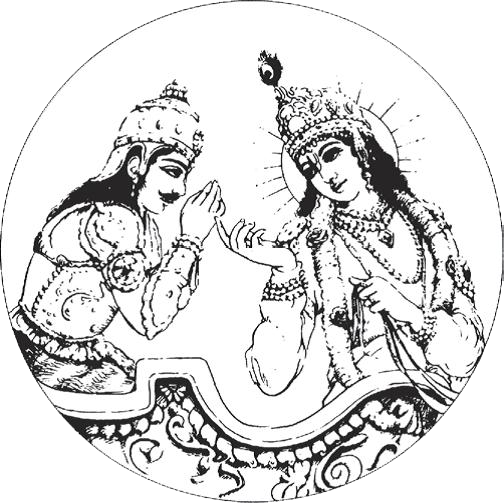
The Bhagavad-gītā is a conversation between a distraught Arjuna and his intimate friend, Kṛṣṇa, the Supreme Personality of Godhead. It is a coherent exchange in which Arjuna presents his doubts and confusions. He finds himself in an impossible situation. As we would say, he feels trapped between a rock and a hard place. He feels that whatever choice he makes will lead to misery. Kṛṣṇa patiently helps Arjuna understand the theistic science of action, which, when properly understood and applied, will help him pass through his impossible dilemma and attain happiness.
Arjuna is not a blind follower. He wants to be certain that what Kṛṣṇa tells him to do is indeed the right path. Thus he probes deeper and questions further, and Kṛṣṇa reciprocates until all of Arjuna’s doubts are gone. Our dilemmas may be different from Arjuna’s, but Kṛṣṇa’s answers, when properly understood, will help us also pass through the difficulties we face.
Both Kṛṣṇa and Arjuna are highly intelligent and deeply learned in Vedic knowledge. Their conversation is therefore tight, layered, and philosophically precise. I think of an astrophysics professor helping a PhD candidate resolve complex doubts. Their discussion would be almost incomprehensible to the average person because they would use specialised terminology and assume large amounts of prior knowledge. To make sense of such a discussion, we would need the help of qualified astrophysicists. In the same way, we need the help of the self-realised ācāryas to unpack and explain this extraordinary, important, and urgently relevant conversation.
Before embarking on this project, I could not see how the verses flowed from one to another. Each verse seemed like a stand-alone aphorism. I often could not even follow the logical development of ideas within a single verse, what to speak of from one chapter to another. I had scrutinisingly studied Śrīla Prabhupāda’s purports for many years, but I could not see the wood for the trees.
However, with the help of His Holiness Bhānu Swami’s translations of Viśvanātha Cakravartī Ṭhākura’s Sārārtha-varṣiṇī-ṭīkā and Baladeva Vidyābhūṣaṇa’s Gītā-bhūṣaṇa, I now see how this divine conversation flows. I finally understand how Kṛṣṇa consciousness is indeed a theistic science and how, when properly understood and applied, it can solve all the problems of life.
I hope Gita Flow will help you see that flow as well. But please understand this clearly: by Kṛṣṇa’s will, the Bhagavad-gītā does not reveal itself through passive reading or hearing. You must actively engage with it.
Repeat what you have heard in your own words. Ask yourself whether you agree or disagree, and explain why. If you understand something differently, articulate your reasoning and support it with śāstric evidence. If you have doubts, confusions, or misgivings, state them honestly. Do not suppress them. Then ask yourself whether you can see any possible resolution. If you have access to devotees you trust, discuss your doubts with them using the Improving Saṅga Principles and Useful Tips.
Then gradually the Bhagavad-gītā will begin to reveal itself to you. It will begin to speak to your heart and help you see, approach, and experience life differently. Śrīla Prabhupāda repeatedly assures us that if we properly apply Kṛṣṇa consciousness, we will become happy. Once we become genuinely happy, we will naturally know how to help others become happy as well.
Please also remember that even self-realised ācāryas sometimes present different perspectives. Therefore, if you understand a verse differently from me, do not panic and assume you must be wrong. Think carefully. Express your understanding clearly and support it with śāstric reasoning as best you can. We currently have a WhatsApp group, IS Interactive, where you can present alternative perspectives and ask for help finding supporting evidence.
Wishing you all success and happiness,
your servant,
Cintāmaṇi-dhāma dāsī
Further chapters of Gita Flow will be made available to participants of our online or in-person Gita Discussion Groups. To join such a group, please connect with us via our WhatsApp group.
Who’s Who in the Gita:
Dhritarastra: The blind king of the Kurus; father of Duryodhana, and paternal uncle of the Pandavas (sons of Pandu). He ascended the throne after the death of his brother, Pandu, and conspired against his nephews in favour of his own sons, the Kauravas.
Sanjaya: Dhritarastra’s chariot driver and secretary. Vyasadeva blessed him that he would be able to see everything that was going on in the battlefield and relate it to Dhritarastra.
Duryodhana: The eldest son of Dhritarastra who wanted to kill his cousins, the sons of Pandu, and take their kingdom.
Dronacarya: The military teacher of both Pandu’s and Dhritarastra’s sons, as well as the princes of other kingdoms, all of whom fought at Kurukshetra. He reluctantly fought on Duryodhana’s side in the war.
Bhishma: Dhritarastra and Pandu’s eldest brother. He had vowed never to become the king, but to always protect the acting king. Because of his vow, he fought on Duryodhana’s side in the war. As he was significantly older than his brothers, his nephews, the Kauravas and Pandavas, saw him as a grandfather figure.
Arjuna: Pandu’s third son, a great warrior and Krishna’s friend and devotee.
Krishna: The Supreme Personality of Godhead who incarnated as a prince in the Yadu dynasty. He acts as Arjuna’s chariot driver and spiritual teacher.
OM TAT SAT
Access Gita Support articles in this series:
How to deepen your study of Chapter 2
How to Use Gita Flow to Deepen Your Study of Bhagavad-gītā As It Is (These suggestions currently apply only to Chapter 2, but we in time will add the relevant material to the other chapters as well.) What Gita Flow Provides There are three downloadable PDFs connected...
Ch. 1 Easy Gita Flow
CHAPTER 1 Gita Flow Note: An asterisk indicates there is an analysis of the verse, which you will find below in the Analyses section. 1.1: Dhritarastra’s question* Dhritarastra asked Sanjaya, “What’s happening at the holy place, Kurukshetra? My...
Ch. 2 Easy Gita Flow
Note: An asterisk at the end of a verse indicates there is evidence related to it, which you will find below in the list of evidences. CHAPTER 2 2.1-3: Krishna scolds Arjuna (1 - 2) Sanjaya said, “When Krishna saw Arjuna so upset about killing his relatives, he said,...
Ch.3 Easy Gita Flow
Note: An asterisk at the end of a verse indicates there is evidence related to it, which you will find below in the list of evidences. CHAPTER 2 2.1-3: Krishna scolds Arjuna (1 - 2) Sanjaya said, “When Krishna saw Arjuna so upset about killing his relatives, he said,...
Gita Support is a work in progress. We will constantly improve it with time. Please feel free to provide us with your feedback on how we can improve it.
For further study of Bhagavad-Gita we recommend:
- Bhagavad-Gita As It Is with purports by His Divine Grace A. C. Bhaktivedanta Swami Prabhupada
- Gita Bhusana with commentary by Srila Baladeva Vidyabhusana
- Bhagavad-Gita with commentary by Srila Vishvanatha Cakravarti Thakura

0 Comments