

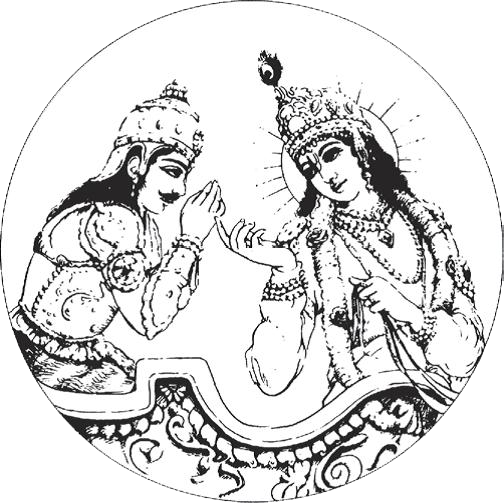
CHAPTER 3
In Chapter 2, verse 39, Krishna introduces buddhi-yoga as a means to liberation. Modern readers, approaching the text calmly, can recognise this as a single, integrated path: action guided by spiritual intelligence.
Arjuna, however, hears Krishna’s explanation of buddhi-yoga amid crisis, not as a detached commentator but as an internally conflicted warrior on the battlefield. Although Krishna clearly instructs him in verses 2.47–48 to perform his duty without attachment, Arjuna misinterprets verse 2.49 to mean that “karma (action) should be replaced by buddhi-yoga.” He also takes Krishna’s description of the sthita-prajña—one firmly established in spiritual intelligence (buddhi-yoga)—in verses 2.55–72 to indicate a renounced, contemplative life.
He mistakenly thinks karma-yoga and buddhi-yoga are two separate paths. Thus, he also misunderstands Krishna’s instruction in 2.50 to mean that only buddhi-yoga frees one from all karmic reactions.
Thus, he cannot understand why Krishna concludes 2.50 by saying he should practise karma-yoga. While detached action in karma-yoga may be better than work performed with attachment, it still accrues karmic reactions. Since he perceives buddhi-yoga and karma-yoga as separate paths, with only buddhi-yoga liberating one from karmic reactions, he struggles to understand why Krishna urges him to act in what he regards as the “lower” discipline of detached action (karma-yoga).
Influenced by these misunderstandings, and by his own inner conflict about fighting, Arjuna raises his doubts at the opening of Chapter 3.
3.1-2: Arjuna’s confusion
(1) Arjuna said, “I understand, Krishna, that buddhi-yoga—a life of spiritual contemplation—is superior to performing one’s worldly duties. If I am understanding you correctly, then why are you urging me to fight in this war? You are Janārdana, the protector of all, and Keshava, the remover of demonic doubts. Please protect me by helping me overcome the confusion in my mind.”1
(2) “Your instructions seem contradictory and confusing. Please tell me in simple, clear terms what I should do.
3.3-9: Duty done for the Lord is better than renouncing work.
(3) The Supreme Lord, Krishna, replied, “Arjuna, I have described two paths of self-realisation. The first, sankhya, requires one to analyse the difference between the spirit soul and the material body. The second is karma yoga, which involves performing one’s God-given duties.2
(4) “It is not possible to stop getting karma by stopping work, nor to achieve self-realisation just by renouncing our family and possessions.
(5) “The soul is always active. Therefore, if you abandon your God-given duties, the modes of nature will impel you to act for sense gratification.
Arjuna’s unspoken question: “But if I take sannyasa, will my duties not be different?”3
(6) “You are fooling yourself if you think you can imitate such a life. One who gives up material duties while still thinking about this world is a false renunciant.
(7) “It is much better to remain in family life and do one’s God-given duties, as an offering to the Lord rather than for oneself.
(8) “Therefore, perform your prescribed duty of fighting, for that is better than renouncing your duties. Everyone must work, if only to preserve the material body.
(9) “When one acts for selfish reasons, there is karma; but when one does his God-given duty to satisfy Vishnu, there is no karmic reaction. Therefore, Arjuna, if you don’t want to incur any karma, you should perform your duty and fight to satisfy Vishnu.
3.10-16: The benefits of working for Vishnu
(10) “When Vishnu created the universe, he introduced the practice of sacrifice for his pleasure. He said this would bestow on humankind everything they needed to live happily in this world and attain liberation after death.4
(11) “By sacrifice, they would satisfy the gods, who would in turn provide them with everything they required. Thus, both humans and gods would prosper.
(12) “The gods provide everything needed to live happily. People should repay them by offering them a portion of what they receive in sacrifice. Those who take from the gods without giving anything back are thieves.5
(13) “Even eating can implicate one in sin if the food is not first offered in sacrifice.6
(14) “People need food to live. To grow food, rain is needed. To make sure there is sufficient rain, people must do their duties as a sacrifice for Vishnu’s pleasure.
(15) “The prescribed duties given in the Vedas come directly from Vishnu. Therefore, there is no difference between His will and Vedic sacrifices.
(16) “Life is meant for attaining self-realisation, which is achieved by sacrifice. Therefore, those who whimsically neglect sacrifice, receive karma and waste the opportunity to become self-realised.
3.17-19: Self-realised souls have no duty
(17) “On the other hand, a self-realised person, fully satisfied serving the Lord, has no material duty.
(18) “Since he has no selfish desire, he has nothing to gain by doing his duty nor anything to lose by not doing it, nor does he need anything from anyone.
(19) “To achieve self-realisation, one must do one’s duty without considering one’s own enjoyment.
3.20-24: Social leaders should set the right
example for others
(20) “In the past, kings such as Janaka achieved self-realisation by performing their prescribed duties. You should also do your duty to set the right example for others.7
(21) “People imitate the behaviour of those they admire. Thus, leaders should teach others how to behave by setting a good example.
(22) “That’s why even I perform the kshatriya duties although I have neither material obligations nor needs.
(23) “If I didn’t do the duties of a kshatriya, then others would imitate me and neglect their duties.
(24) “By setting such a bad example, I would encourage others to act irresponsibly. Consequently, children will be born out of wedlock and, being neglected, will grow up to cause a great disturbance in society.
(25) “Materialists perform their duty to enjoy the benefits, whereas transcendentalists do so to set the right example for others.
(26) “Transcendentalists should not discourage materialists from doing their duties. Instead, by their example, they should show them how to dedicate their duty to the Lord, so they too can gradually realise the Supreme.8
3.27 – 30: the difference between a conditioned and a self-realised soul’s actions.
You may be wondering what the difference is between a self-realised and conditioned soul if both engage in the same work.
(27) “The ignorant person influenced by false ego thinks he is working independently of the Supreme Lord and takes credit for the results of his work. He doesn’t realise his body and mind are controlled by the modes of nature, which are under the Lord’s direction.9
(28) “A self-realised person does not act for sense gratification because he knows he is different from the body and mind, and that as an eternal soul, satisfaction can only come from the Lord’s service.10
(29) “Conditioned souls do their duties to secure material happiness and thereby become more and more materially attached. The self-realised, although recognising their folly, do not discourage them from doing their duty.
(30) “Knowing all this, Arjuna, do your duty for my pleasure. Give up your reluctance to fight, the desire for selfish enjoyment, and the false notion that anyone or anything belongs to you. Fight because I, the Supreme Lord, desire it.
3.31- 35: Doing one’s duty for Krishna’s pleasure
is always good
(31) “Anyone who has faith in and executes my instructions will become free of karmic bondage. If, at present, they are unable to properly implement my order, if they at least do not doubt it but wish they could implement it, they will also eventually become free from bondage.11
(32) “But those who, out of faithlessness, oppose my authority and thus neglect my directions are foolish and will fail in all their endeavours.
(33) “Even the jnana yogis who, desiring liberation, cultivate transcendental knowledge, are obliged to act according to the modes of nature controlling the mind and body. No one can suppress their nature.12
(34) “That’s why there are rules to regulate how people indulge their likes and dislikes. Don’t abandon the rules and be led by your material desires, for that will impede you from achieving self-realisation.”
(35) Arjuna, you want to do a brahmin’s duty and be non-violent because you think that is better and easier than your own duty. However, it is always best to do your own duty, even if that involves some apparent immorality. It would be better for you to die doing your own duty than to do someone else’s. To follow another’s path is sinful and therefore dangerous.13
3.36: Arjuna’s question
(36) Arjuna said, “Why are we compelled to sin, even against our will?”
37 – 43: Lust is the problem
(37) Krishna said, “When the soul’s original pure love of God contacts the mode of passion, it turns into lust. Lust is the root of all sin and, therefore, our greatest enemy. It can never be satisfied and turns into anger, which is very destructive.14
(38) “Lust affects the soul to different degrees: slightly, moderately, and intensely. A slight covering of lust is compared to smoke covering fire. Although it obscures the flames, the fire can be made to blaze by proper handling. Similarly, humans are slightly covered by lust, for although it obscures their real consciousness as my eternal servants, by proper practice, they can revive this consciousness. Birds and beasts are covered by a moderate degree of lust, which is compared to the dust on a mirror, which obscures one’s reflection. Similarly, due to lust, animals and birds have only a faint realisation of their existence. Finally, a foetus in the womb illustrates the extreme degree of lust covering immobile living beings, such as trees and mountains, who have no awareness of themselves as conscious beings.
(39) “Thus, the soul’s eternal enemy, lust, obscures one’s pure spiritual knowledge. Lust can never be satisfied, just as fire cannot be satiated by feeding it with any amount of fuel.
(40) “It controls our senses, mind and intelligence. When intelligence is influenced by lust, we forget we are spirit souls and falsely identify with our material bodies and senses. All the senses feed impressions of enjoyment into the mind, which confuses these for genuine happiness.
(41) “Therefore, Arjuna, immediately check lust by following the regulative principles of devotional service, vaidhi bhakti, for lust is the greatest obstacle to transcendental knowledge and self-realisation.”15
(42) “People think that by controlling the powerful senses, lust can be defeated. They do not know that the mind is more powerful than the senses, for it is the mind which determines the engagement of the senses. Intelligence is even more important than the mind because it can discern, and this influences the mind’s choices. More important than intelligence is the spirit soul, who is the one hankering for enjoyment.16
(43) “Therefore, knowing that the soul is superior to the intelligence, mind and senses, practise buddhi yoga to connect the soul to Me. You will then experience a higher spiritual happiness, your intelligence and mind will become spontaneously attracted to Me, and your senses will no longer hanker for sensual gratification. Thus, you will destroy the formidable enemy, lust.”17
CHAPTER SUMMARY:
In Chapter 3, Krishna addresses Arjuna’s misunderstanding of His earlier teachings. Arjuna had assumed that Sankhya and Buddhi Yoga referred to a single path. To correct his misunderstanding, Krishna explains they are two paths, and He reframes them as Jnana Yoga (Sankhya) and Karma Yoga (Buddhi) to make His meaning clearer.
Krishna explains that one cannot attain the renunciation of the Jnana Yogis merely by imitating their external lifestyle while internally still being attached to material enjoyment. However, when a materially attached person acts in karma yoga, offering the results of his work as a sacrifice for the pleasure of the Supreme, he will not get any karmic reactions, and he will gradually become purified of his material attachments. He further advises Arjuna that as a leader in society, even if he has no material attachments, he should act in karma yoga to set the right example for others.
He gives a list of differences between those who do their duty but still have some attachment for the result, and those who do their duty without attachment. Both types of people benefit by doing their duty. Arjuna asks why people neglect their duties. Krishna states that the root cause is lust, which bewilders a person’s discrimination and drives them to act against their best interest. He concludes that the solution is to spiritualise the intelligence: Buddhi Yoga.
Access Gita Support articles in this series:
Gita Support – Introduction
Gita Support Introduction: Bhagavad-gita is a chapter of the epic Mahabharata, available in both complete and condensed versions. It is a ‘transcendental mystery’ (Bg 4.3) which Srila Prabhupada told us to discuss from different perspectives. “And I am very much...
Gita Flow – Ch. 1
CHAPTER 1 Gita Flow Note: An asterisk indicates there is an analysis of the verse, which you will find below in the Analyses section. 1.1: Dhritarastra’s question* Dhritarastra asked Sanjaya, “What’s happening at the holy place, Kurukshetra? My...
Gita Flow – Ch. 2
Note: An asterisk at the end of a verse indicates there is evidence related to it, which you will find below in the list of evidences. CHAPTER 2 2.1-3: Krishna scolds Arjuna (1 - 2) Sanjaya said, “When Krishna saw Arjuna so upset about killing his relatives, he said,...
Gita Support is a work in progress. We will constantly improve it with time. Please feel free to provide us with your feedback on how we can improve it.
Footnotes:
- Verse 3.1: “Sometimes Krsna consciousness is misunderstood to be inertia, and one with such a misunderstanding often withdraws to a secluded place to become fully Krishna conscious by chanting the holy name of Lord Krsna.” Bg 3.1 purport
“Keśī was a most formidable demon who was killed by the Lord; now Arjuna is expecting Kṛṣṇa to kill the demon of doubt.” Bg 18.1 purport
- Verse 3.3: “Kṛṣṇa consciousness means to take instruction from Kṛṣṇa.” Lecture Bg 2.1-11 – Oct. 17, 1975, Johannesburg
- Between 3.5 and 3.6: Arjuna’s doubt: “But sannyasa, renunciation of activities, means a negation of all tendencies for both Vedic and material activities, does it not?” VCT 3.5 commentary
- Verse 3.10: “This verse shows that it is wrong to maintain the body without offering sacrifice to Visnu.” Baladeva Vidyabhusana 3.10 commentary
- Verse 3.12: “To make this point clearer, he speaks of the fault of not performing this activity. He who enjoys for himself alone, not giving to the devatas through panca maha yajna a portion of the objects which the devas originally bestowed for the worship of the Lord, is a thief.” Gita Bhusana 3.12 commentary
- Verse 3.13-16: “Śrī Kṛṣṇa says that “Don’t stop your work, but by the result of your work, you try to make sacrifice for the cause of the Supreme. Then your entanglement will be automatically loosened.” The whole energy which you apply in your industry, if the result is offered to Kṛṣṇa, that means that energy is utilized for Kṛṣṇa—not for that industry, but for Kṛṣṇa. That is the thing. Just like Arjuna. What was he? He was a military man. That technique is that Arjuna, in the beginning, he did not like to fight, because he wanted to gratify his senses. He thought that “I shall be happy if I do not fight with my kinsmen, because in the fighting my kinsmen will die, and I shall be sorry. So what is the use of fighting like this?” That means the whole thing, whole program, is according to his own sense gratification. He did not know that this war field, this battle of Kurukṣetra, was organized by Śrī Kṛṣṇa to kill all unwanted men of the world at that time. All unwanted men of that world. That was His plan.” Lecture on Bhagavad-gītā 3.13–16; 23/05/1966; New York
- Verse 3.20: “By prescribed actions as well as hearing Janaka and others attained realisation of atma.” Baladeva Vidyabhusana’s Gita Bhusana 3.20 commentary
- Verse 3.26: How can we dedicate our duties to Krishna? Srimad Bhagavatam tell us: “By hearing about and glorifying the Lord, all a person’s activities become molded into spiritual activities, and thus all conceptions of material miseries become completely vanquished.” Srimad Bhagavatam 2.1.5 purport
“He does not know that this gross and subtle body is the creation of material nature, under the order of the Supreme Personality of Godhead, and as such his bodily and mental activities should be engaged in the service of Kṛṣṇa, in Kṛṣṇa consciousness.” Bg 3. 27 purport - Verse 3.27: “The doubt may arise: how to distinguish the person in knowledge from the ignorant person, if the man in knowledge also performs actions. Two verses explain the difference.” VCT 3.27 commentary.
“He does not know that this gross and subtle body is the creation of material nature, under the order of the Supreme Personality of Godhead, and as such his bodily and mental activities should be engaged in the service of Kṛṣṇa, in Kṛṣṇa consciousness.” Bg 3. 27 purport
- Verse 3.28: “He knows his real identity as part and parcel of the Supreme, who is eternal bliss and knowledge, and he realizes that somehow or other he is entrapped in the material conception of life.” Bg 3.28 purport
- Verse 3.31: “Those who follow My teachings, and even those who cannot follow but have faith and also do not disrespect the teachings – even they can be free of the bondage of action. Even though at present time they cannot follow, by faith in the teachings and lack of envy, their obstacles decrease. A little later, by performing the instructions, they become free.” BVB 3.31 commentary
- Verse 3.33: According to CC M 24.121, a person advanced in knowledge is a jnani. There are 3 levels of jnanis: those desiring liberation, those who are liberated, and those who have realised Brahman. The authors understand all three stages of jnanis are subject to the influence of the modes of nature.
“Yes, self-realization, simply understanding “I am not this matter,” is also external because there is chance of falldown. But when you are actually engaged in Kṛṣṇa’s service, that is positive platform of self-realization.” https://vedabase.io/en/library/transcripts/760623gcnv/?query=Self+realized+falldown+#bb382311
However, if attaining Brahman realisation they take to bhakti then they are free. This we surmise from Srila Prabhupada’s comment in the purport that “Unless one is situated on the transcendental platform of Krsna consciousness, he cannot get free from the influence of the modes of material nature, as it is confirmed by the Lord in the Seventh Chapter (7.14).”
“So therefore sense gratification must be stopped. But if you want to stop it artificially it is impossible, neither by this yoga process, neither by this jñāna process…… So sense gratification, you cannot stop artificially.” Bg lecture in 1968, Los Angeles - Verse 3.35: To understand what is meant by ‘even though faultily’ we referenced Bg18.48 verse. VCT seems to support this perspective in his commentary to verse 3.35: “In this verse the Lord answers those who desire to perform the duties of others such as non-violence, because it is easy to execute and also not independent of dharma, and because of inability to fight the battle due to attachment and repulsion. One should boldly perform one’s duties, even though they may have some slight fault. This is better than performing others’ duties even if those duties are executed well and are full of good qualities.”
Krishna explains why it is dangerous to do someone else’s duty in Bhagavad-gita chapter 18, verses 59-60.
In his commentary to 3.35, VCT also says: “The seventh canto of Bhagavatam speaks of performing others duties, para dharma, as irreligion:…”There are five branches of irreligion, appropriately known as irreligion (vidharma), religious principles for which one is unfit (para-dharma), pretentious religion (abhasa), analogical religion (upadharma) and cheating religion (chala-dharma). One who is aware of real religious life must abandon these five as irreligious. Srimad Bhagavatam 7.15.12” - Verse 3.37: “‘But after the fulfilment of desire, the desire should be finished.’ ‘No, this lust is a great devourer. It is impossible to satisfy the expectations of desire.’” VCT 3.37 commentary
- Verse 3.41: “Nonetheless, Krsna consciousness is so powerful that even a later beginner can become a lover of God by following the regulative principles of devotional service. So, from any stage of life, or from the time of understanding its urgency, one can begin regulating the senses in Krsna consciousness, devotional service of the Lord, and turn the lust into love of Godhead….” Bg 3.41 purport.
We understand the regulative principles of devotional service refers to vaidhi bhakti. “As mentioned in the previous verses, there are two kinds of devotional service: the way of regulative principles and the way of full attachment in love to the Supreme Personality of Godhead.” Bg 12.12 purport - Verse 3.42: “You have shown that lust can be destroyed by controlling the senses through inclining them to niskama-karma-yoga. This is like water held back by a closed dam. But at the time of performing activities related to the body (while not performing prescribed actions), with the freedom of action for the senses, lust will again revive, like water freed from a dam. The Lord shows in two verses what He taught before in chapter two, that lust will be completely destroyed by realization of atma: raso’py asya param drstva (Bg 2.59)……..The mind is superior to the senses, because the mind sets the senses in motion during the waking state, and during sleep, the mind remain as a ruler, while the senses merge into it. Intelligence is superior to the mind, because the intellect’s function of determining truth (niscaya) brings about the mental function of decision (sankalpa). That w hich is superior to the intelligence is the jivatma residing in the body, whose very form is knowledge (cit-svarupa). Being realized as distinct from the body, senses, mind and intelligence, it is the cause of complete destruction of lust.” Baladeva Vidyabhusna’s commentary to Gita Bhusana 3.42
- Verse 3.43: “Understanding that the jivatma is superior to intelligence, understanding that it is separate from all coverings, destroy lust, which is difficult to conquer, by being firmly fixed in the self.” VCT 3.43 commentary

0 Comments