

The 10 Principles
Principle Two
Principle Three
Principle Four
Principle Five
Principle Six
Principle Seven
Principle Eight
Principle Nine
Principle Ten
Download Ten Principles Pdf
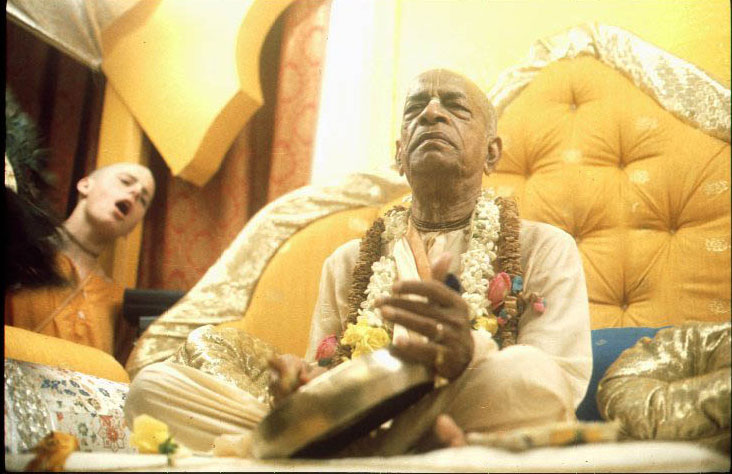
1. Discuss Srila Prabhupada’s Books With Family Members And Friends
“So you European, American students, you take full advantage of this Vedic culture. I am therefore so much laboring hard that we, before my leaving this body, I may give you some books you can enjoy after my death. So utilize it. Utilize it. Read every sloka nicely, try to understand the meaning, discuss amongst yourselves. Nityam bhagavata-sevaya. That is our mission. Nasta-prayesv abhadresu nityam bhagavata-sevaya (SB 1.2.18). Abhadra, we have got so many dirty things within our heart. So these dirty things can be cleansed simply by Krishna consciousness. There is no other method.” (Lecture on Srimad Bhagavatam 1.1.1 in London, on July 6th, 1972)
“Generally, people cannot understand. But if one understands, he becomes liberated. If some way or other….it is not very difficult; simply we have to associate with devotees and discuss this literature. Then we will understand Krishna very easily.” (Lecture on SB 6.1.39 - Los Angeles, June 5, 1976)
“Be engaged always in reading Srimad-Bhagavatam, discussing amongst yourself. Then you’ll make progress. Otherwise, if you take it as an official routine work… You should take as routine work, but with consciousness that “We have to learn something,” not simply attending the class, but to learn something. In this way make your life successful. Because after all, everything is being done daiva-coditāt, impelled by the Supreme Person. The Supreme Person is behind everything. So in the association of devotees, if we read Śrīmad-Bhāgavatam regularly, then your..., our material contamination will be dissolved, and our spiritual consciousness will come out, and that will make our life successful.” (Lecture SB 3.26.41, Bombay January 16, 1975)
“One need only chant Hare Kṛṣṇa, Hare Kṛṣṇa, Kṛṣṇa Kṛṣṇa, Hare Hare/ Hare Rāma, Hare Rāma, Rāma Rāma, Hare Hare, accept the remnants of foodstuffs offered to Kṛṣṇa, have some discussion on books like Bhagavad-gītā and Śrīmad-Bhāgavatam, and engage oneself in Deity worship. These four things will make one happy. One should train the members of his family in this way.” Bg 13.8-12 purport
“For a devotee, there is no point in making friendships with ordinary persons; he should make friendship with other devotees so that by discussing among themselves they may elevate one another on the path of spiritual understanding. This is called iṣṭa-goṣṭhī.In Bhagavad-gītā there is reference to bodhayantaḥ parasparam, “discussing among themselves.” Generally pure devotees utilize their valuable time in chanting and discussing various activities of Lord Krishna or Lord Caitanya amongst themselves. There are innumerable books, such as the Purāṇas, Mahābhārata, Bhāgavatam, Bhagavad-gītā and Upaniṣads, which contain countless subjects for discussion among two devotees or more.” SB 3.29.17 purport
“The messages of the Supreme Personality of Godhead are full of potencies, and these potencies can be realized if topics regarding the Supreme Godhead are discussed amongst devotees…Discussion of Krishna is very potent, and if a fortunate person has such association and tries to assimilate the knowledge, then he will surely make advancement toward spiritual realization.” Bg 9.1 purport
Why this Principle is important:
One might ask why we must discuss Srila Prabhupada’s books. Why not read other devotees’ books which are easier to understand than Srila Prabhupada’s? Initiated devotees sometimes say they prefer to read their diksa guru’s books. Still others tell us they prefer to read Srila Prabhupada’s books by themselves, rather than discuss them with their family members or friends. Below we explain why we feel it is important to read and discuss Srila Prabhupada’s books.
Why we must hear from Srila Prabhupada:
Unless we hear from a “self-realised”, “liberated, “unalloyed” devotee, we cannot make spiritual advancement.
“The summary is that one has to first of all seek the association of pure devotees who not only are learned in the Vedanta but are self-realized souls and unalloyed devotees of Lord Sri Krishna, the Personality of Godhead.” S.B. 1.5.34 purport
“One should take shelter of a pure devotee, who has nothing to do with this material world but is simply engaged in devotional service. By serving him only, one can transcend the qualitative material condition. In this verse, it is recommended (yogesvara-upasanaya) that one serve the lotus feet of the topmost yogi or the devotee. To serve the topmost devotee means to hear from him about the glories of the Supreme Personality of Godhead.” SB 4.22.22
“The topmost benediction for those who are living in this material world and are subjected to the repetition of birth and death is association with pure devotees. One should search out such pure devotees and remain with them. That will make one completely happy, even though living within the material world.” SB 4.30.34 purport
“Therefore one must learn detachment by discussion of spiritual science based on authoritative scriptures, and one must hear from persons who are actually in knowledge. As a result of such discussion in the association of devotees, one comes to the Supreme Personality of Godhead.” Bg 15.3-4 purport
“Unless one hears from a bona fide ācārya, who is never disturbed by the changes of the material world, one cannot have the real key to transcendental knowledge.” Sri Isopanisad mantra 13 purport
“Reporter (2): What will happen to the movement in the United States when you die? Prabhupada: I will never die. I shall live forever in my books, and you will utilise.” (Press conference – July 16, 1975, San Francisco)
Indian man (2): Personally, we think more greater.
Prabhupāda:
“That's all right. But still, you can associate with me by reading my books.” (Morning Walk in Toronto, 1975)
Failure to follow this principle will ruin everything:
If we do not apply this first Principle, we will not make spiritual advancement or fulfil Srila Prabhupada’s mission.
“What is the value of this association? Sat-saṅga. Sat-saṅga means assembly, discussion. Bodhayantaḥ parasparam, tuṣyanti ca ramanti ca. If you are not interested in association, discussion, then you are finished. So… karmīs, they are fools and rascals. When you have got this center, it is not that you should be engaged from morning till you go to bed for sense gratification. That is not life. That is karmī’s life. You have no time for sat-saṅga, for association. You cannot make any progress by this sort of karmī’s life. We have to work for organization, but not that whole day and night engaged and no sat-saṅga. That is a misguided policy, and it will spoil the whole structure. … (long pause) … In Los Angeles, they regularly assemble during ārati and class. If this regulative principle is lost, then you are karmīs.” (Room conversation, New Delhi, Nov 3, 1973)
“So this is difficulty, that we are not very much interested in hearing. And that is the main business. Our bhakti begins ... śravaṇaṁ kīrtanaṁ viṣṇoḥ (SB 7.5.23). We have to hear and we have to speak. But if we are not interested in hearing and speak, then it will be the same ṭhākura-bari, simply formula. That's all. And gradually it will be stopped. Unless there is life of śravaṇaṁ kīrtanam, these big, big building, temples, will become burden. So if we are..., if we want to create burden for future, then we may give up this hearing and chanting and sleep very nicely. It will be burden. Galagraha. Not śrī-vigraha, but galagraha. Galagraha. Śrī-vigraha means worshipable Deity. So if we give up this śravaṇaṁ kīrtanaṁ viṣṇoḥ (SB 7.5.23), then it will be thought that ‘Our Guru Mahārāja has given a burden in the neck, galagraha.’ This is the danger. So we must be very much alert in śravaṇaṁ kīrtanam. Otherwise, all this labor will be futile. This building will be only the nest, nest for the doves and the pigeons. That is the danger.” (Lecture on Srimad Bhagavatam 1.8.19 on September 29th, 1974 in Mayapur)
“Woman devotee: Well, people are instructing with these chanting sessions.
Prabhupāda: Because that is offense. Guror avajñā. First offense is guror avajñā, defying the authority of guru. This is the first offense. So one who is offensive, how he can make advance in chanting? He cannot make. Then everything is finished in the beginning. Guror avajñā. Everything is there. If one is disobeying the spiritual master, he cannot remain in the pure status of life. He cannot be śikṣā-guru or anything else. He is finished, immediately. Guror avajñā śruti-śāstra-nindanam, nāmno balād yasya hi . . . (Padma Purāṇa). You do not study all these things. You become initiated . . . there are ten kinds of offenses. Do you have any regard for these things or not? You must avoid these ten kinds of offenses. The first offense is to disobey the orders of guru. That is first offense. So if you are offensive, how you can become advanced by chanting? That is also not possible.
Woman devotee: Can we just have the chanting without instructions?
Prabhupāda: But that chanting must be pure. Your guru is writing books. If you think, “There is no necessity of reading books,” that is guror avajñā. Do you mean to say I am writing these books whole night for selling and making money? Why do you think like that?
Woman devotee: So there should just be chanting and reading of the books.
Prabhupāda:
“Yes.” (Lecture on Bg 17.1-3, Honolulu, 1974)
Download Ten Principles Pdf